
Underfloor Heating: The Uncomfortable Truth
Heated slabs make intuitive sense in small residential spaces. In large shops and barns, they turn the wrong surface into the primary heat source, which leads to slow response, cold structure, condensation, and long runtimes.
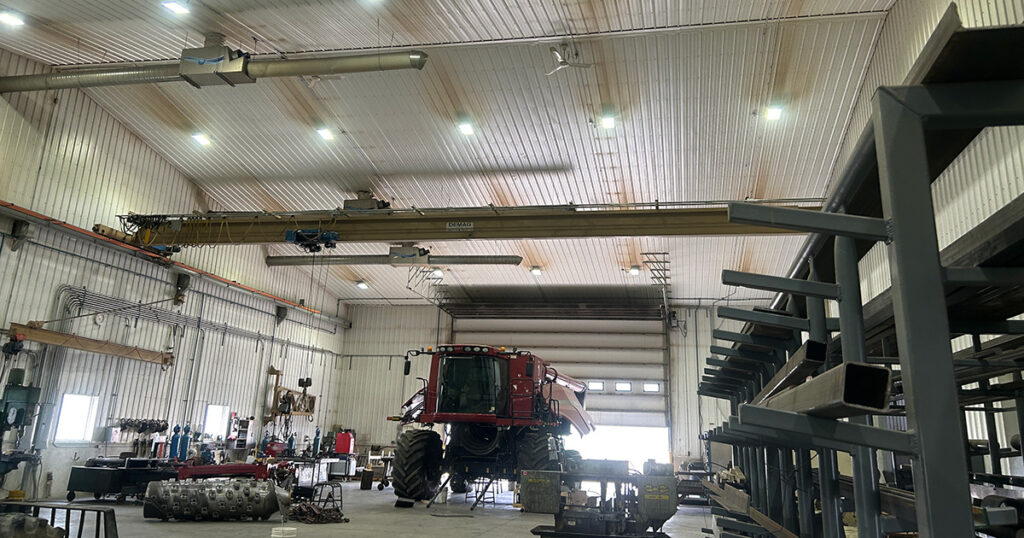
Underfloor Heating: The Uncomfortable Truth
Hydronic underfloor heating works well in small spaces — bathrooms, basements, residential garages. In a large shop, the physics change. A heated slab is capped at about 20–38 BTU/hr/ft² of output by safety standards, while a cold-climate shop can lose more than that. The heat that does rise pools at the cold roof, drains through it, and falls back down along the walls as cooled air — crossing the worker zone on the way back. Meanwhile every cold structural surface (roof, walls, overhead doors) collects moisture from the warm shop air, leaving grime, rust, and frozen door seals. The slab’s thermal mass also makes it too slow to respond to weather swings; by the time it catches up to a cold morning, the afternoon is already warm again. Overhead low-intensity infrared reverses the approach — it warms the structure directly, so surfaces stay close to air temperature, moisture has nowhere to land, and the system responds in minutes instead of days.
For decades, hydronic underfloor heating has been the default choice in large shop construction. The reasoning feels intuitive. Heat rises. A floor is the largest single surface in a building. If you can warm the slab, surely the rest of the room will follow.
And in small spaces, that logic holds. Basements, residential garages, bathrooms, utility rooms — places where surfaces are close together, air turnover is low, and comfort is measured within a few feet of the floor. The slab warms, the room warms, and the system delivers what the brochure promises.
The trouble begins when that same approach gets stretched into a building that is nothing like a basement.
A large shop is a wide, tall, constantly ventilated structure. Air volume is enormous. Structural surfaces are far apart and mostly cold. Overhead doors cycle all day long. Equipment rolls in from outside. Air pressure shifts with every weather change. In that environment, the floor stops being a comfort surface and becomes a heating strategy — and strategies have to be judged by what they actually deliver, not by what they promise in a showroom.
What follows is what happens when heat begins at the slab in a tall industrial volume. Not in theory. Not in showroom demonstrations. In the real-world physics of a working building.
Why underfloor heating struggles in shops.
The pitch is simple: heat the slab, and the building will follow, because “heat rises.”
It seems reasonable until thermodynamics enters the room.
The problem isn’t that a warm floor is wrong. A heated slab is a useful surface. It feels good underfoot, and when it’s part of a building where everything else is also warm, it adds to comfort instead of carrying the load alone.
The problem is what happens when the slab becomes the only heat-active surface in the building.
In a tall, open shop, the floor sits at the bottom of the building and carries the most thermal mass. Warm air does rise off it — but it pools at the ceiling. Concrete responds slowly to load changes. And to push enough heat upward into the worker zone, the slab has to be driven well above the temperature anyone would actually choose underfoot.
That means:
- a colder day requires a hotter slab
- every weather swing lags by hours
- the entire building has to endure the temperature required at the floor
And if workers want more comfort at shoulder height, the slab has to run hotter — long before the heat ever reaches them.
This isn’t a radiant strategy. It’s a single surface trying to carry an entire building — pushing heat upward through concrete, air, and ceiling space, hoping enough of it catches on the way back down.
The “radiant” claim — and where it falls short in a shop.
Hydronic brochures often describe heated slabs as “radiant systems.” The label isn’t wrong — any warm surface emits some infrared energy, and a heated slab is no exception. But brochures rarely show how much infrared is being emitted, or what that intensity actually does inside a tall building.
The numbers tell a clear story.
The math comes from ASHRAE. A heated hydronic floor delivers approximately 2 BTU per hour per square foot for every °F of difference between the slab surface and the room air. Roughly 70% of that heat leaves the floor as radiation. The rest is free convection.
ASHRAE Standard 55 caps the floor surface temperature at 84°F in occupied spaces. In a 65°F shop, that puts the slab’s maximum heat output around 38 BTU/hr/ft². At a more comfortable 75°F slab, output drops to roughly 20 BTU/hr/ft². That is the slab’s ceiling.
A large shop on a cold winter day — older insulation, frequent door cycling, high air infiltration — can lose 50–60 BTU/hr/ft². The slab is running at full capacity and still falling short.
So a hydronic slab is radiant. But it’s a low-intensity, long-wavelength emitter, capped by safety standards at modest surface temperatures. And it can only thermally activate the surfaces it can directly see — which in a working shop means very little. Vehicles, lifts, benches, tool chests, and equipment block the floor’s view of the walls, doors, and structural steel that actually need to be warmed.
The remaining heat output leaves the slab by convection — warm air rising off the surface and drifting upward into the ceiling space. Which is exactly the place a tall shop can least afford to send its heat.
So in practice:
- the slab’s maximum output is capped well below what a large shop loses on a cold day
- it can only radiate at the surfaces it can directly see, and most of those are shadowed by equipment
- whatever heat doesn’t leave by radiation leaves by convection — straight up into the ceiling
This is why the radiant claim fades fast in a large shop. Not because the slab isn’t emitting infrared, but because it isn’t emitting enough infrared, in the right direction, to thermally activate the structure.
What goes up must come down.
A shop worker does not live on the floor.
They live roughly 34 to 68 inches above it, surrounded by cold tools, trucks, steel, walls, doors, lifts, and bays.
To heat that world from below, the slab has to send warmth up through a tall column of cooler air. Most descriptions of “heat rises” in a shop stop there — as if the warm air simply travels upward unchanged, fills the upper part of the building, and eventually drifts back down to warm the middle.
That is not what actually happens.
When the slab warms the air immediately above it, that air becomes less dense, and buoyancy pushes it upward. But it does not rise unchanged. As it climbs, it mixes with the cooler air it passes through — a process called entrainment. The rising plume gets bigger and cooler as it goes. Some heat is also lost sideways into cold walls, columns, and equipment the plume brushes against. By the time it reaches the upper part of the building, a significant share of the heat it started with is already gone.
Then it hits the ceiling.
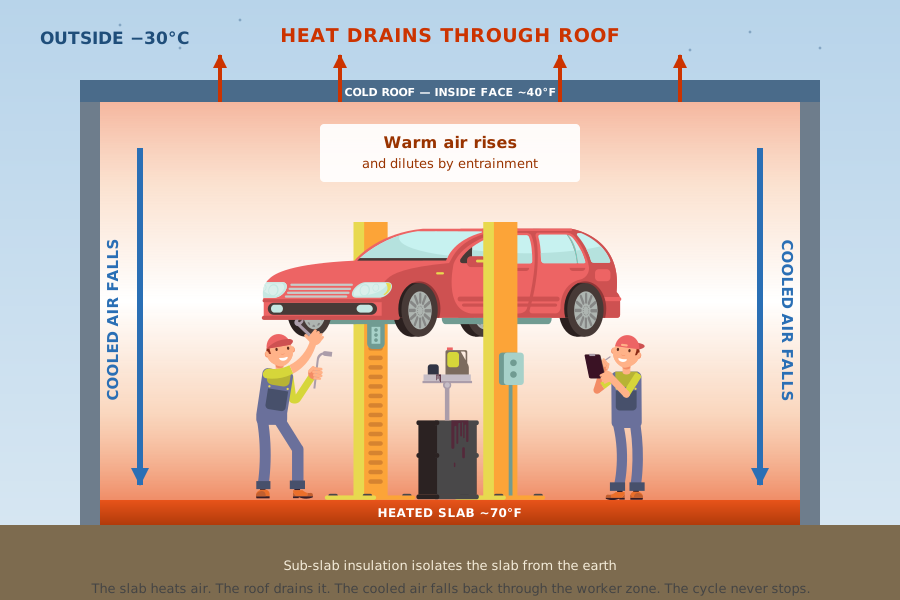
This is where the real damage happens in a cold climate. The ceiling is one of the coldest surfaces in the building. On a -30°C day, the inside face of an industrial roof can sit at 35–45°F. The warmest air in the shop arrives there and immediately starts dumping its heat into the cold roof — which then conducts that heat straight through to the cold air outside. The ceiling never gets “full” of warmth. It gets drained, continuously, every minute the slab is running.
Now the air that gave up its heat at the ceiling is denser than the air below it. It starts to fall, usually sliding down along the inside of the exterior walls as a sheet of cooled air. That cooled air mixes back into the middle of the shop — exactly where the workers are. So the system runs a continuous loop:
- the slab heats air at the floor
- the rising air dilutes itself by mixing with cooler air on the way up
- whatever heat reaches the ceiling drains immediately through the cold roof
- the now-cooled air falls back down along the walls
- the falling cooled air crosses the worker zone on its way back to the slab
The worker zone catches the cooled air on its way back down — never the warm air on its way up. Meanwhile, the structural surfaces in the worker zone — toolboxes, doors, lifts, vehicles — stay much colder than the air moving past them.
Real-world operation makes the loop worse. Every overhead door opening dumps the warmest air at the top of the room out of the building first, because that’s where the warm air has pooled. The system has to rebuild from the floor up before the middle of the room can stabilize again. And the slab can never get ahead. As long as the roof stays cold and the doors keep cycling, the loop closes faster than the slab can break it — round and round, every minute the system runs.
A cold day does not change the direction of any of this. It just makes every step more aggressive. The bigger the inside-outside temperature gap, the faster the roof drains. The faster the roof drains, the colder the air falling back down. The harder the slab has to work to compensate.
So the floor has to run hotter than comfort requires, just to overcome losses on the way up — and on the way back down.
And that exposes the core flaw of slab heating in a tall shop:
Hydronic floors attempt to warm the shop from the lowest surface upward — slowly, weakly, and through every cold surface on the way up. True radiant systems start with the structure itself. The building becomes the heat source.
Thermal inertia vs. industrial reality.
Concrete holds enormous thermal mass. That sounds comforting until the environment changes.
When the outdoor temperature swings, when overhead doors cycle, when equipment rolls in from deep cold, when humidity spikes in the wash bay — the slab cannot respond for hours. A thick commercial slab can take one to two days for cold-start warmup. Once heated, it can’t shed energy quickly either.
The building temperature ends up chained to concrete inertia. Which means:
- too hot long after sunny weather arrives
- too cold long after doors close
- slow to recover after every heat loss
- constant over-correction cycles
This isn’t just hour-to-hour fluctuation. It plays out at the season scale too. A spring or fall day where the temperature drops thirty degrees overnight — a kind of weather Western Canada gets every year, sometimes into June — is exactly the scenario a hydronic system can’t handle. The slab needs the better part of a day to register the change and longer than that to actually catch up. By the time it has the building back to comfort, the weather has already shifted back to warm and the slab is now overheating into an afternoon that no longer needs it. The system spends entire shoulder seasons chasing yesterday’s weather.
And it isn’t just comfort that pays the bill. On a sunny February afternoon, free solar gain is already warming your shop through the doors and skylights — but the slab doesn’t know. The boiler keeps firing because the slab core is still below setpoint, even as the air in the building overshoots. You’re paying for heat the sun is already giving you. Multiply that across thirty years of shoulder-season afternoons and the fuel waste is not small.
A properly designed overhead radiant system answers the same temperature drop within minutes. By the time the slab would have started to respond, the structure has already been warmed back up. Same building, same weather — two completely different response times.
Shops need agility. Instant output. Fast shutdown.
The insulated slab paradox.
This part is rarely mentioned during the sales pitch.
Insulated slabs trap heat even when the system is off.
For a hydronic slab to function in winter, sub-slab insulation is required — ASHRAE Standard 90.1 mandates a minimum of R-3.5. That insulation also severs the slab’s connection to the earth, which holds a stable temperature of roughly 13°C year-round. Without insulation, an earth-coupled slab would moderate the building passively, in both directions. With insulation, that connection is gone.
So in summer, even with the boiler off:
- the slab still holds energy
- the space never feels truly cool
- floors radiate warmth when no one wants it
- doors and fans become necessary just to normalize the building
A controlled study at the Centre for Sustainable Building in Poland found that removing sub-slab insulation reduced indoor air temperature by nearly 4°C during a heat wave — and held that benefit regardless of duration. The earth doesn’t warm up and lose effectiveness. But a properly functioning hydronic slab never has access to it.
The available workarounds are propping doors open all summer, or running chilled glycol back through the loops. Many shops eventually install cooling loops just to remove heat from the slab they paid to insulate.
Translation: you pay to heat the floor in winter, and you pay to cool it in summer. Only because hydronic design required insulating the slab in the first place.
Zoning problems: one slab equals one temperature reality.
Different zones in a working shop demand different comfort levels:
- wash bays require aggressive heat
- bench work prefers a neutral environment
- welding zones tolerate hotter conditions
- storage corners need very little
But hydronic systems spread heat through one monolithic mass. Even with loop segmentation, everything is interconnected through concrete.
If you raise wash-bay temperature to combat dampness, you raise the thermal load everywhere. If mechanics want cooler floors to reduce fatigue, the entire slab cools.
Personal comfort is impossible because the platform is unified.
• • •Humidity and condensation: the silent structural cost.
Unless slabs are run aggressively hot, they often under-deliver heat to the upper structure.
The result: warm, moisture-bearing air contacts cold surfaces like walls, columns, overhead doors, and steel framing.
Condensation forms. Then:
- stuck dust
- grease lines
- rust on tools
- streaked overhead doors
- discolored paint
Every pass of the recirculation loop brings warm, moist shop air into contact with cold structural surfaces. The air gives up its heat to the cold mass — and on the way, it gives up its moisture too. Walk into any long-running hydronic shop and look up. The ceiling tells you everything.
What you see is not heat transfer. It’s grime, moisture streaks, and corrosion — the record of every cold morning the building has gone through, written into the structure itself.
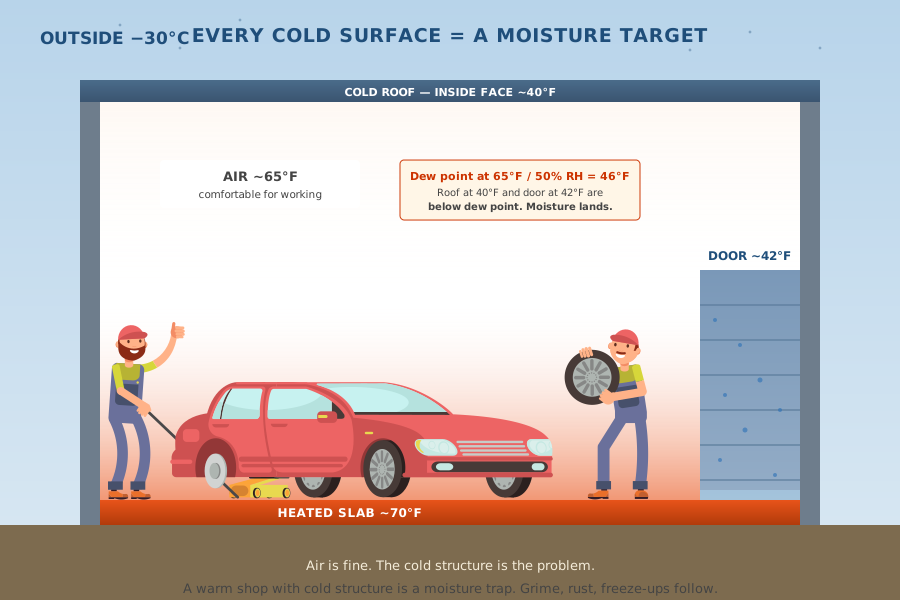
The math is straightforward. At 60°F and 50% relative humidity, the dew point is about 41°F. At 60% RH it climbs to 46°F. Any surface colder than that dew point will collect moisture from the air around it. In a hydronic shop with cold structure, that threshold is met every single day.
Overhead door freeze-ups: condensation’s worst symptom.
When hydronic slabs under-deliver heat to the upper structure, overhead doors stay colder than the surrounding air. Panels, rails, track hardware, and especially rubber seals all sit below the dew point. Warm, moisture-bearing shop air hits those cold surfaces and condenses.
On mild days it shows up as beads or damp streaks. When temperatures snap below freezing, that moisture locks up. Door seals bond to the floor. Gaskets harden. Rails frost and bind. Panel edges freeze together. Door motors strain against ice.
Ask any shop that relies on large doors: freeze-ups are not an accident — they are physics. If a structural surface stays colder than the air touching it, moisture will land on it. If temperatures are below freezing, that moisture becomes ice.
With true low-intensity infrared systems, the door structure is warm. Panels equilibrate with the building. Gaskets stay pliable. Tracks shed moisture instead of collecting it. No cold surfaces means no condensation — and no freeze-ups.
Shop owners switching from hydronic slabs to radiant systems report the same thing after their first winter:
Where physics turns against hydronics.
Wash bays generate warm, saturated air on purpose. In a hydronic shop, that air has nowhere good to go.
The walls, overhead doors, and ceiling steel all stay cold. Warm moist air contacts them, gives up its moisture, and leaves behind streaks, dirt lines, rust, and corroded hardware. That’s what shows up on the structure.
But on colder days, something more visible happens to the air itself. The bay fogs. Warm humid air meets cooler air pockets near cold walls and doors, water vapor condenses into airborne droplets, and visibility drops. Workers can’t see across the bay. Doors haze over. Vehicles sit for hours before they’re dry enough to leave. The wash is over, but the building is still raining.
Where mass is fully warmed and surfaces sit close to the air temperature, the dew point math doesn’t change — but there’s nowhere for the moisture to land. Surfaces stay above the dew point. Bays dry quickly. Walls stay clean. The fog clears.
The slab is doing what it was designed to do. The building is still cold.
The final physics problem.
Underfloor heating attempts to use heat stored in one surface — the slab — to warm a building full of unheated mass.
Walls, doors, equipment, steel, benches, lifts, stairs, tools — all remain colder than the air.
These surfaces become:
- heat sinks
- condensation targets
- comfort killers
Shops do not need warm floors. They need:
- warm mass everywhere
- consistent surface temperatures
- no cold nodes
- no condensation anchors
What this looks like when you actually measure it.
This argument is not theoretical. It has been measured directly.
In January 2017, surface temperatures were taken in two Western Canadian shops on the same day at about -35°C outside. In the hydronic shop, the floor read 69.9°F while a metal overhead door read 42.1°F — a 28-degree spread inside one building. In the infrared shop down the road, every measured surface sat within 3 to 4 degrees of each other.
The hydronic slab was doing exactly what it was designed to do. The floor was warm. The building was still cold.
The full data set is in The Hidden Temperature in Your Shop. What that data confirms is the physics laid out above — that a heated slab in a large shop produces hot floors and cold everything else, and that the gap between those two numbers is where condensation, rust, freeze-ups, and long runtimes live.
What real radiant systems do differently.
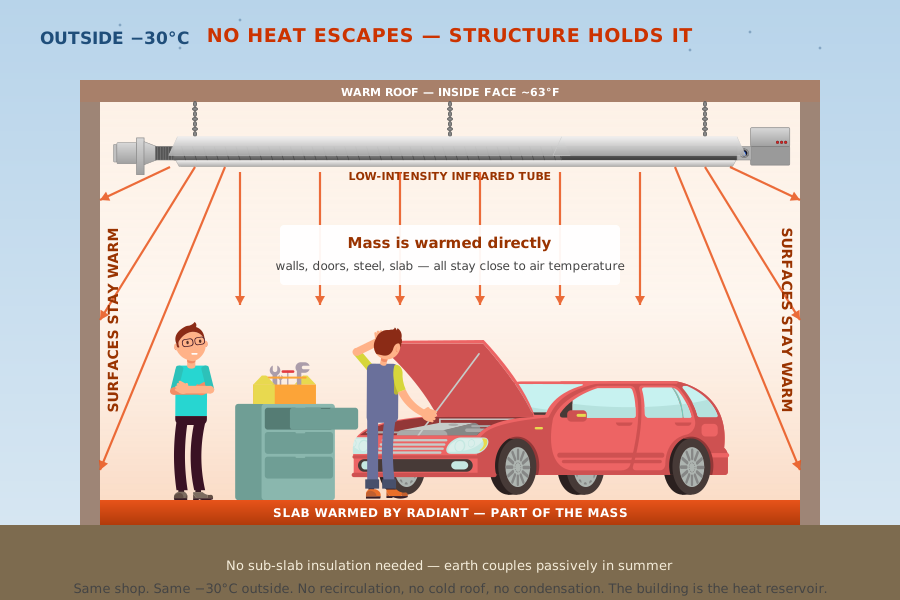
A true low-intensity infrared system reverses the starting point. It begins at the ceiling and throws infrared directly into the walls, tools, steel, equipment, slab, benches, vehicles, doors, and structural surfaces — so everything becomes thermally active.
As that mass equilibrates:
- temperatures stabilize
- humidity collapses
- condensation disappears
- comfort profiles tighten
- response time accelerates
- wash bays dry fast
When summer shutoff comes, the space immediately returns to neutral. There’s no insulated slab trapping heat. The building vents naturally.
And because the entire building becomes the heat reservoir, the system cycles less often. True efficiency is runtime. When the mass of the building does the heavy lifting, the burner doesn’t have to.
That difference shows up in the operating bill. Comparable Western Canadian shops report hydronic operating costs around $0.37 per square foot annually. Properly designed overhead infrared runs $0.10 to $0.17. The full breakdown is in The Real Cost of Hydronic Slab Heating.
Conclusion.
Hydronic underfloor heating has earned its place in small residential spaces, where rooms are low, surfaces are close, thermal loads are predictable, and comfort is judged within a few feet of the floor.
But in large shops — especially in northern climates or ventilated agricultural barns — the physics change.
Tall building volumes, cold exterior walls, heavy moisture cycles, wash stations, rapid weather swings, continuous air turnover, and worker comfort demands all expose the structural limitations of slab-based heat.
Slow reaction time, condensation risk, summer discomfort, overheating cycles, worker fatigue, and higher operating costs are not quirks. They are consequences tied directly to thermodynamics.
If heat begins at the floor, you end up battling heat stratification, thermal inertia, and cold mass. But when heat begins at the structure — as with true low-intensity infrared radiant systems — the entire building becomes the reservoir.
The air will follow.
That’s the uncomfortable truth — and it’s why a heated slab can be doing exactly what it was designed to do, while the building it sits in is still cold.
Check your own shop. Don’t take our word for it. A $40 infrared thermometer settles the argument in two minutes.
Point it at your floor. Then at the inside face of your overhead door. Then at the ceiling. Then at the inside of the exterior wall, halfway up.
In a true uniform-envelope shop, those four numbers sit within four or five degrees of each other. In a hydronic shop on a cold day, the spread is often twenty-five degrees or more — and the problem isn’t the floor. It’s everything else.
If your numbers don’t line up with what we’ve described here, we want to know. If they do, you already have the picture.
This article reflects independent research and analysis of infrared radiant heating principles by Enviro-Smart Inc. It is intended for educational purposes and does not represent official technical literature, engineering position, or product claims of Combustion Research Corporation. All conclusions, interpretations, and recommendations expressed herein are solely those of the author.
Related articles from the same lane.

Reflect-O-Ray Radiant Heat in a Commercial Greenhouse
Side-by-side field observations from a working greenhouse: floor temperatures, root-zone temperatures, slab conduction, and what Reflect-O-Ray's flattened tube profile did for plant response over...
Read article
Quicker. Faster. Further. Stronger. Safer.
Two heaters can both be called "radiant" and behave nothing alike. Reflect-O-Ray's low-mass aluminized spiral tubing changes five specific things about how a radiant...
Read article
Let There Be Light
Infrared is the warming part of sunlight — invisible light that travels through cold air without warming it, then sinks into solid surfaces and...
Read article