
Reflect-O-Ray Radiant Heat in a Commercial Greenhouse
Side-by-side field observations from a working greenhouse: floor temperatures, root-zone temperatures, slab conduction, and what Reflect-O-Ray's flattened tube profile did for plant response over seven seasons.
Reflect-O-Ray Radiant Heat in a Commercial Greenhouse
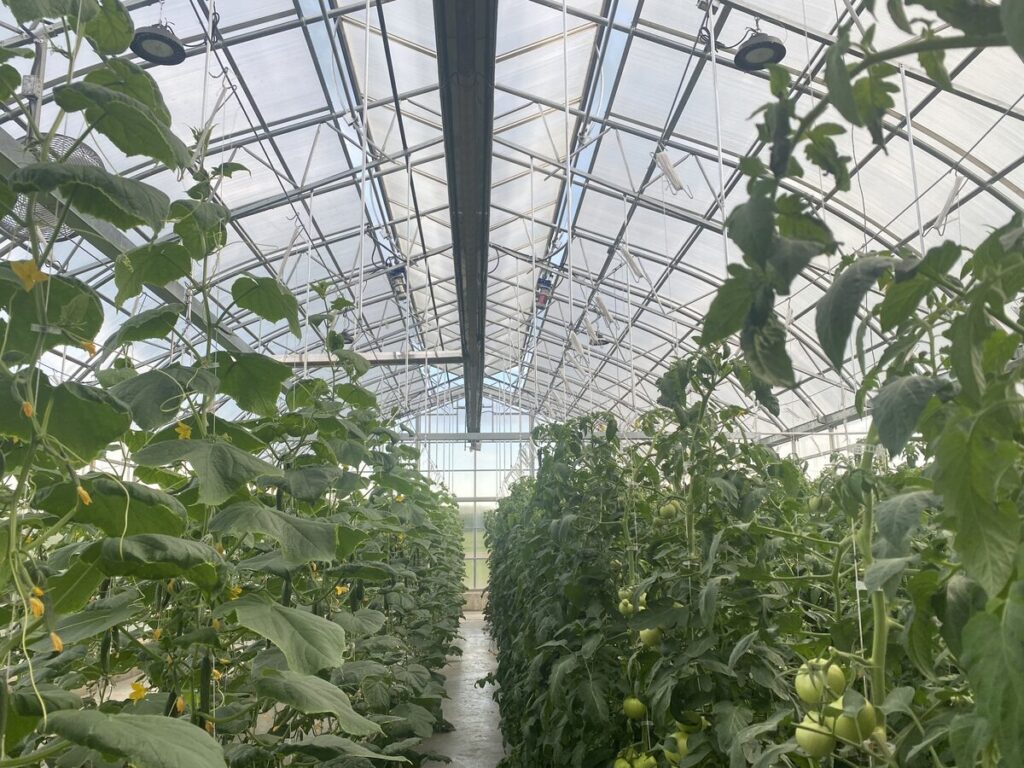
In March 1984, Combustion Research Corporation ran two identical 42′ × 80′ greenhouses side-by-side at the same 70°F (21°C) thermostat set point — one heated by Reflect-O-Ray low-intensity infrared radiant tube, one by forced hot air. The Reflect-O-Ray house held set point on 195,000 BTU/hr, with a 74°F floor and 72°F root-zone temperature. The forced-air house burned 26% more fuel (246,667 BTU/hr) and still ran 12°F below set point, with a 51°F floor and 48°F root zone. Across seven seasons of operation, the grower’s report documents fungal disease stopping in the radiant houses, finishing times dropping (marigolds in bloom 21 days from transplant), and a 6,000-flat Begonia crop rescued from a fungal outbreak by ramping radiant heat to 95°F for three days during high humidity.
During the mid-1980s, Combustion Research Corporation ran side-by-side comparisons of low-intensity infrared heating against conventional forced-air and hot-water systems inside two identical 42′ × 80′ houses on a Michigan grower’s property.
The observations went beyond fuel usage alone. Floor temperatures, root-zone temperatures, crop response, humidity behavior, fungal pressure, and energy usage were all tracked during side-by-side greenhouse operation.
The findings below are drawn from Mr. Martin’s 1986 grower report of Green Gardens Greenhouse & Nursery, Lake Orion, Michigan, and supporting 1984 field-test data from Combustion Research Corporation.
The operation
At the time, Green Gardens Greenhouse & Nursery, run by R. Martin in Lake Orion, Michigan, covered 60,000 square feet of growing area under sixteen-year-old fiberglass, finishing bedding plants and seasonal flowers for the retail market. By 1985, R. Martin had been working through various radiant configurations for seven years, alongside hot water boilers and forced hot air. Each conventional setup produced the same recurring complaints: temperature variations through the building, hot and cold spots near walls and doors, irregular growth from flat to flat, recurring fungus and damp-off during humid stretches, and fuel costs that swung with the weather.
Combustion Research Corporation, the manufacturer of Reflect-O-Ray, designed a system specific to the houses: low-intensity infrared radiant tube heat, sized and configured for the building’s volume, geometry, and growing schedule. The tubes warm the floor, the growing medium, the plants, and the structure directly. A secondary cascade reclaimed remaining exhaust energy for reuse elsewhere in the operation.
“After much study and research they developed a system tailor-made for our greenhouses. The results were excellent. Our temperatures are very even now, much more so than they were with the hot water system. We now recover wasted exhaust heat and use it to heat our water which we water the plants with. Our surplus hot water is now pumped through the concrete floors and heats the cement from below.”
— R. Martin, June 18, 1986
Fuel use
After conversion, Martin removed the boilers and the piping for the hot-air units entirely. The fuel bill dropped by more than half. The electric bill dropped as well, because the motors and blowers that the forced-air system depended on were no longer running.
“Our fuel savings are in excess of 50% of what they were. We used to heat with hot air and hot water. We have since removed our boilers and piping in the hot air units. We have found the radiant heat to be very dependable and requires very little maintenance. Our electric bills have dropped substantially because we are no longer running so many motors and blowers.”
— R. Martin
Martin projected a three-year payback on the system. The CRC field tests run at his property the year before showed the underlying physics directly: the radiant house ran on roughly 195,000 BTU per hour over a 24-hour period, while the forced-air comparison house burned 246,667 BTU per hour and still failed to hold its set point.
Air and root-zone temperatures
Two identical 42′ × 80′ greenhouses were run side-by-side in March 1984 at the same 70°F (21°C) thermostat set point with 32°F (0°C) outside air, and measured over 24 hours. The Reflect-O-Ray house held its set point. The hot-air house never came close.
Air & Floor Temperatures
Two 42′ × 80′ greenhouses side by side · Outside air 32°F (0°C) · Thermostat set 70°F (21°C)


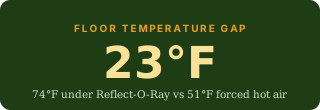



The radiant house held 70°F (21°C) at canopy height with a 74°F (23°C) floor and 72°F (22°C) growing medium — what the thermostat asked for. The hot-air house averaged 58°F (14°C) in the air, 51°F (11°C) at the floor, and 48°F (9°C) at the root zone — twelve degrees below set point with the burner running flat out. The hot-air house used 26% more fuel to produce that worse result.
The roof-line temperatures read cold under both systems — 49–50°F (9–10°C) under Reflect-O-Ray, 50°F (10°C) under forced air. That reading isn’t really about the heating system. Greenhouse glazing has effectively no R-value; the inside surface of a poly or polycarbonate roof sits a few mils away from the outside air, so an IR-thermometer reading at the peak is essentially measuring outside conditions through a thin film. Both systems show the same cold ceiling because the building envelope is the same at the top. The real comparison happens at the floor.
Reflect-O-Ray puts 74°F (23°C) at the floor and 72°F (22°C) in the growing medium where the plants live. Forced hot air leaves the floor at 51°F (11°C) and the medium at 48°F (9°C). The 23°F (13°C) floor-temperature gap is the difference between the two systems. Forced hot air also pushes heat toward the part of the building that is effectively a window to the outside, so a significant share of those 246,667 BTU/hr leaves through the polyfilm before reaching a plant. Reflect-O-Ray puts heat into the slab and lets it work its way up through the canopy before it gets anywhere near the leak.
To bring the hot-air house’s root-zone temperature up to the 72°F (22°C) the Reflect-O-Ray house was already holding, CRC’s engineers calculated the forced-air system would have needed 616,667 BTU/hr — 3.16 times the radiant system’s fuel consumption.
Lateral conduction through the slab
A second CRC test set two greenhouses side-by-side, sharing a common wall and one continuous concrete slab. The left half was heated by Reflect-O-Ray; the right half by a comparison heating system. Outside air was 28°F (−2°C). The floor temperatures showed something more interesting than uneven heat: the Reflect-O-Ray slab was actively conducting heat sideways through the concrete into the neighbor.
Floor Temperatures Across a Shared Slab
Two adjacent 42′ × 80′ greenhouses · One continuous concrete slab · Outside air 28°F (−2°C)
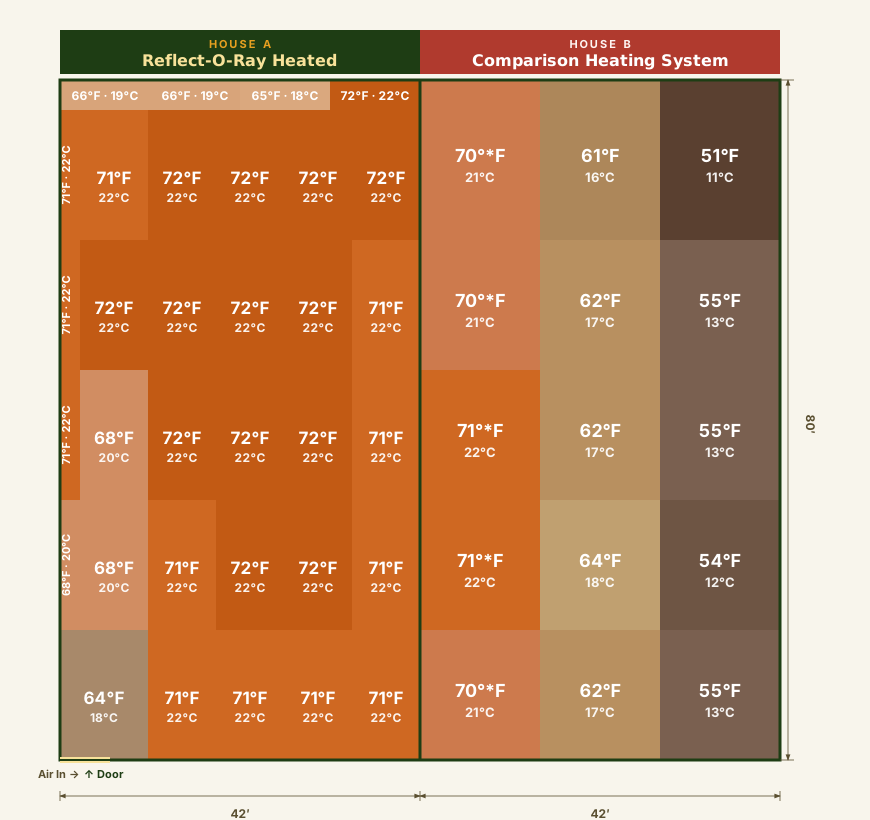



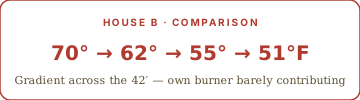
On the Reflect-O-Ray side, the floor reads 71–72°F (22°C) across the full 42 feet of width, with mild edge cooling at the door (64°F / 18°C) and the back wall (65–66°F / 18–19°C). Every interior reading sits inside a 4°F (2°C) band. On the comparison side, the floor temperatures fall off in a smooth gradient as you move away from the shared wall: 70°F (21°C) in the column adjacent to the Reflect-O-Ray slab, 62°F (17°C) in the middle column, and 51–55°F (11–13°C) at the far exterior wall. That is not the pattern of a heating system with its own hot spots and cold spots; it is a conduction gradient through concrete.
The warmth in the comparison house’s floor along the shared wall isn’t from its own burner — it’s heat travelling sideways through the continuous concrete from the Reflect-O-Ray slab. The comparison heater is barely warming its own floor.
Two practical observations follow. First, the Reflect-O-Ray slab is warm enough — and concrete is conductive enough — that the slab itself acts as a passive heat-distribution medium. That is why the Reflect-O-Ray side reads 71–72°F (22°C) uniformly across all 42 feet even though the radiant tubes overhead don’t cover every square foot equally. The concrete smooths out the radiant pattern. Second, the same conduction that warms the neighbor’s adjacent slab is heat being lost from the Reflect-O-Ray system. The 195,000 BTU/hr figure in Figure 1 was therefore measured against a cold neighbor pulling conducted heat through the shared wall; without that load, the radiant house’s BTU usage would have been lower still.
Humidity, fungal pressure, and the Begonia rescue
The most striking outcome across Martin’s seven years of experiments was what radiant heat did to fungal disease. In the radiant-heated houses, fungus stopped appearing. Direct comparisons — moving infected plants from a forced-air house into a radiant house — produced the same result: the fungus stopped spreading and the plants recovered. Damp-off on seedlings stopped occurring entirely. Geraniums began rooting in 7 to 10 days. Seedlings came up harder, with less stretch.
The clearest illustration was a 6,000-flat Begonia crop he nearly lost in the summer of 1986. With outside air at 80°F (27°C) and seven days of high humidity, he ran the radiant heat up to 95°F (35°C) as a last resort:
“An example of this is we recently had 6,000 flats of Begonias that were packed tight because we were low on space. We had 7 days of rain with high humidity and high temperature. Our lower leaves were beginning to mold even though we were using fungicides. Our fans were on constantly yet the condition grew worse. In a last attempt to save the crop we turned the radiant heat on to a setting of 95°F and continued to run the exhaust fans (our outside air temperature was 80°F). Immediately the fungus stopped spreading and 3 days later had ceased completely. We delivered the plants to our customer in excellent condition. Without radiant heat we would surely have lost the crop and this example alone, radiant heat saved us $36,000.00.”
— R. Martin
The mechanism is direct: radiant heat warms surfaces without saturating the air with moisture, so leaf surfaces stay drier and the conditions fungal spores need to germinate never develop. Combined with a dry, warm floor, the greenhouse becomes a hostile environment for the things that ruin bedding plant crops. The $36,000 figure is in 1986 dollars — about $100,000 today.
Crop response
Once the radiant system was in, Martin began seeing crop turnarounds that had not been possible under forced air. He attributed them to stable nighttime temperatures and a warm growing medium in the flats.
Moon Shot and Apollo marigolds finished in bloom 21 days from transplanted seedlings. Impatiens transplanted on April 10 were ready for market by May 10. Geraniums rooted in half their previous time. Cloudy weather no longer stalled plants. Stalks stayed hard, color stayed dark green, bloom dates held.
“We have found also that during cloudy weather, plants do not stall or stretch while being heated with radiant heat. The stalks are very hard, the plants are dark green and bloom on time regardless of sun conditions. We are able to rapidly accelerate growth of our plants and double the crop.”
— R. Martin
The radiant house held 72°F (22°C) growing medium while the forced-air house next door sat at 48°F (9°C) — a 24°F (13°C) gap at the root zone. Root metabolism roughly doubles for every 18°F (10°C) of root-zone temperature, which is the simplest physical explanation for the finishing-time differences he was seeing.
Insect pressure during the heating season
Martin reported one observation he could not fully explain but recorded consistently across seven years: insect pressure in the radiant-heated houses dropped to nothing during the heating season.
“Also for some unknown reason we have no insect problems during the heating season while the radiant heat is on. I suspect the insect eggs are dehydrated thus preventing them from hatching. Our greenhouses are covered with 16 year old fiberglas and our light levels are low. The plants flower well and don’t stretch. However, in the houses that are heated with hot air we do have problems with stretch and meeting our blooming dates.”
— R. Martin
His hypothesis — that infrared dehydrates eggs before they hatch — is unverified. The operational effect, however, was consistent: under radiant heat, the heating season ran without the pest interventions the forced-air houses needed.
Thermal mass and a gas-service outage
Because Reflect-O-Ray heats surfaces directly — the concrete slab, the walls, the growing medium — the building’s mass accumulates a substantial heat reservoir during normal operation. When gas service was interrupted during cold weather, the stored heat in the concrete and plants carried the greenhouse through the night passively, without an active burner running:
“This winter we also experienced an interruption of gas service during extremely cold weather and because the amount of heat stored in our cement floors and plants we were able to go through the night with no major frost damage. In our forced air house we lost what we had planted to frost.”
— R. Martin
Worker comfort
A smaller but consistent observation: employees preferred working in the radiant houses. Radiant heat warms surfaces and people directly — the slab, the walls, the plants, and the workers’ clothing and skin — rather than just warming air. The result is warmer surroundings without having to push hot air around.
“Our employees prefer working in the radiant heated house over the forced air; they feel warmer.”
— R. Martin
By the end of 1986, Martin had committed to converting all 60,000 square feet of greenhouse to Reflect-O-Ray.
Why this radiant configuration works in a greenhouse
Radiant tube heat is unusual in a greenhouse — and for good reason. The burner end of a conventional pressure radiant system runs around 1000°F (538°C), hot enough that a plant canopy directly underneath can scorch. The temperature also collapses rapidly down the tube, leaving a hot front of the building and a cold back. Bedding plants can’t tolerate either condition, which is why most growers stay away from radiant in a greenhouse altogether.
Reflect-O-Ray works in a greenhouse because the temperature profile is flattened along the entire run. A vacuum fan at the far end of the tube draws the flame and combustion gases down its full length, instead of letting the heat concentrate at the burner. The first section of tube is insulated to reduce the front-end surface temperature; the rest is low-mass spiral tubing that radiates that heat efficiently down the run. In longer buildings, paired burners share a single central vacuum exhaust, extending the same even profile across spans that would otherwise require a chain of separate radiant systems.
Reusing the exhaust energy
The radiant tubes warmed the building directly. A second engineering layer captured the energy that would otherwise have vented outside and put it back to work inside the operation. Radiant-tube exhaust enters a water cooler at ~160°F (71°C) and leaves at ~70°F (21°C). Each tube yields 3 gallons of recovered hot water per minute, heating the water from 51°F (11°C) up to 105°F (41°C). That hot water is used for irrigation at 100°F (38°C); any surplus is circulated through the floor as additional thermal storage. The 70°F (21°C) exhaust air is then blown down the gutters from outside, which also helps melt snowfall off the structure.
The radiant tubes are what made the building’s environment work for the plants. The cascade is what made the energy bill smaller by refusing to throw heat away.
“We believe that our radiant heating system has kept us in business. In fuel savings alone we are looking at a three-year pay back. We now are able to grow year round profitably.”
— R. Martin, June 18, 1986
Combustion Research Corporation builds the Reflect-O-Ray system. Enviro-Smart Inc. installs and services it across western Canada and the northern United States — in greenhouses, poultry houses, weaner barns, and other temperature-sensitive growing environments, alongside shops, industrial buildings, and any setting where even, efficient infrared heat does the job.
Enviro-Smart Inc. — (587) 747-3753 — envirosmartinc.com
Source: Greenhouse Report by R. Martin, Green Gardens Greenhouse & Nursery, Lake Orion, Michigan, June 18, 1986. Supporting field data: Combustion Research Corporation, March 30, 1984.
Related articles from the same lane.
Quicker. Faster. Further. Stronger. Safer.
Two heaters can both be called "radiant" and behave nothing alike. Reflect-O-Ray's low-mass aluminized spiral tubing changes five specific things about how a radiant...
Read article
Let There Be Light
Infrared is the warming part of sunlight — invisible light that travels through cold air without warming it, then sinks into solid surfaces and...
Read article
The Grime Line Time-Line
Underfloor heating in a tall shop deposits moisture wherever surfaces sit below the dew point. After a decade that grime line is visible from...
Read article