
Let There Be Light
Infrared is the warming part of sunlight — invisible light that travels through cold air without warming it, then sinks into solid surfaces and heats them directly. A Reflect-O-Ray tube heater puts out the same warming part of sunlight, with the visible glare and the UV stripped out.

Let There Be Light
Infrared is the warming part of sunlight — invisible light that travels through cold air without warming it, then sinks into solid surfaces and heats them directly. A Reflect-O-Ray tube heater puts out the same warming part of sunlight, with the visible glare and the UV stripped out. The result is a building heated from the floor up, the way the sun heats the earth, instead of from the ceiling down, the way every furnace fights gravity.
When the sun rises over a field of standing wheat, no one stops to think about how it warms the ground. It just does. The frost lifts. The day begins.
That warmth — the part of sunlight you feel on your skin before you’ve even taken your jacket off — is exactly what a Reflect-O-Ray tube heater puts into a building. Not similar. The same. And once you see why, almost every other question about heating buildings starts to answer itself.
What light actually is.
The word light usually means the stuff you can see. A bulb. A window. A flashlight beam. But that’s a small slice of a much bigger family — and the part your eyes can see sits in the middle of it.
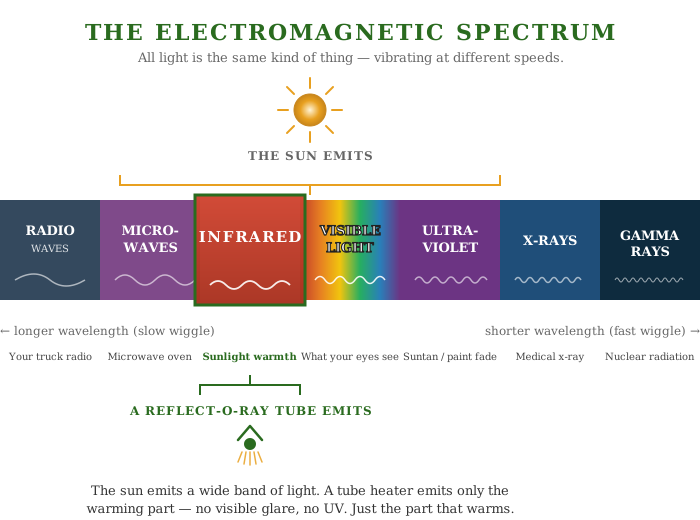
Radio waves are light. Your truck radio is pulling them out of the air right now. So are microwaves — same physics, different speed, which is why your kitchen microwave heats coffee instead of broadcasting a country station. Infrared comes a little further along, then the rainbow your eyes can see, then ultraviolet (the part of sunlight that tans your skin and bleaches the paint on your truck), then X-rays and gamma rays.
All of it travels at the same speed. The only thing that changes is how fast it vibrates — and that one difference is enough to make radio waves pass through walls, visible light bounce off them, and infrared sink into them and turn into heat.
Infrared, specifically.
Step out of the shade into the sun on a cool morning. The air didn’t change. Your face just got warmer.
That’s the moment worth paying attention to, because something specific happened that doesn’t get talked about much: the sun didn’t heat the air on its way down. The air between you and the sun is freezing — actual vacuum for most of the trip, and thin cold atmosphere for the last few miles. The infrared travels straight through all of it without warming any of it, and only releases its energy when it hits something solid. Your skin. The pavement. The hood of a tractor. A cow’s back. A concrete shop floor.
Then — and only then — does the warm surface start heating the air around it.
This is the order that everything else follows from:
The concrete under your boots holds more warmth at sunset than the air above it. That’s not a coincidence — the concrete got the warmth directly, and the air is getting it secondhand. Every plant, animal, and field on earth has lived under this arrangement for as long as there has been a sun, and none of it would work the other way around.
The other kind of heat.
A furnace does the opposite. It burns fuel, heats air, and blows the hot air into the building. Once that air arrives, it does what hot air always does — it rises.
So a barn or shop heated by forced air has its warmest layer at the ceiling and its coldest layer at the floor, exactly where the animals or workers happen to be. To keep the floor livable you have to overheat the ceiling, and every door opening sends that overheated air outside. The system is fighting gravity in the background of every single operating hour.
This is convection heat — heat carried by moving air. It works, and people have used it forever. But most of its energy collects near the ceiling, where nobody is standing.
Radiant heat doesn’t have that argument with the building. It travels in straight lines from wherever it’s emitted, the same way light from a flashlight does, and it lands wherever it’s aimed.
How a radiant tube heater works.
A Reflect-O-Ray tube heater works on the same principle as the sun, scaled down and pointed at a building floor.
Fuel burns at one end of a long steel tube. The combustion gases travel the length of the tube; the tube surface heats up; and once it’s hot enough, it starts emitting infrared in every direction. Same physics as the sun, the wood stove, and a hot car hood in July. Anything hot enough emits infrared. That’s not a Reflect-O-Ray feature; that’s a property of warm matter.
The tube emits infrared upward, downward, and sideways all at once — but only the downward portion is useful. The rest would just warm the ceiling. This is why every Reflect-O-Ray system has a polished aluminum reflector running along the top of the tube: it catches the upward and sideways infrared and projects it down toward the floor, where it’s needed.
What lands on the floor below isn’t a hot spot under one bright source — it’s a long, even sheet of warmth falling on everything in the path. Floor. Walls. Equipment. Feeders. Animals. Workers. The air it passes through on the way down barely warms at all, because air is mostly transparent to infrared, the same way it’s mostly transparent to visible light.
Why this heats a building better.
Once the floor and walls and contents have absorbed the warmth, they become the heat source. They radiate gently back into the air around them. The building warms from the inside out instead of from the top down.
What this changes — and it’s not obvious until you watch it happen — is how the building behaves when it loses heat. Open a door on a forced-air building in January and the warm air rushes out, taking the heat with it; the furnace starts over from scratch. Open the same door on a radiant-heated building and the air leaves, but the floor is still warm, the walls are still warm, the steel and concrete and animals are still warm. Within minutes, those warm surfaces have re-warmed the incoming air. The heat didn’t leave because most of the heat wasn’t in the air to begin with.
The same principle handles condensation. A furnace-heated building has hot ceilings and cold floors, and wherever cold surfaces meet warmer air, moisture collects: damp corners, sweating ceilings, frost on the inside of the steel. Radiant heat warms the surfaces themselves, including the ones where condensation would form. Floors stay drier. Steel stays frost-free. In a barn, the bedding improves and the smell drops. In a shop, tools stop sweating. In an industrial space, the streaks on overhead beams disappear.
This is what we mean by activating the mass of the building. The mass — the floor, the walls, the equipment, the animals, the people — becomes a slow heat reservoir. It evens out the temperature swings the way a thick concrete wall evens out the temperature of a basement. The building does the work the furnace would otherwise be doing every minute of every cold day.
Is sun infrared the same as tube-heater infrared?
Almost.
The sun emits light across a wide band — visible, ultraviolet, infrared, all leaving together and arriving together. Some of it tans you, some of it bleaches the paint, some of it warms you. A radiant tube heater is much cooler than the sun (the sun’s surface is around 10,000°F; a Reflect-O-Ray tube operates well below that, in the radiant-emission window) and because it’s cooler, it emits a narrower band. Almost entirely infrared. No ultraviolet at all.
So what comes off a tube heater is the warming part of sunlight, isolated. No glare. No UV. No paint fade. Just the part that warms.
For animals, that distinction matters more than it might sound. They feel the warmth land on their backs the way they’d feel it on a sunny afternoon, but without the bright source, without the squint, without the UV exposure they’d get outdoors. The behavior is consistent enough across hundreds of barns to be worth naming. Animals settle under radiant heat. They lie down. They spread out instead of crowding around a stove or a vent. Producers describe their barns as calmer.
• • •What you need to make this work in a building.
A few practical things follow from all of this, and they explain why engineered radiant systems are designed the way they are.
The tube has to be hot enough — but not too hot. Below roughly 400°F, a steel surface emits very little infrared. It’s warm to the touch, but it’s just a hot pipe doing weak convection, not radiant work. At 1000°F or above, the radiation gets intense enough to be uncomfortable for animals or workers underneath, and it concentrates in a narrow zone instead of spreading. Useful radiant heat lives in a window between those extremes — and keeping the entire length of the tube inside that window, burner end to far end, is what separates a system that works from one that doesn’t.
The reflector has to be aimed. Infrared travels in straight lines, and a reflector that’s the wrong shape or angle sends the heat somewhere other than the floor. A properly engineered reflector is a mirror for invisible light, and like any mirror, the geometry determines where the image lands.
The layout has to match the building. A tube puts down a footprint of infrared with edges. A building is a rectangle, not a circle, so one tube down the middle leaves the corners cold no matter how big the heater is. Engineered systems are laid out to match the room — straight runs for narrow buildings, H-patterns for wide ones, U-runs where obstacles demand them — so every square foot of floor receives the same gentle dose.
These three details are where systems diverge. Two heaters both labeled “radiant” can behave nothing alike: one drops a hot spot under the burner and runs cold by the back end; another delivers even low-intensity warmth across the entire floor. The difference isn’t in the brochure — it’s in the tubing, the burner configuration, the exhaust design, and the layout pattern. (For a closer look at why most radiant systems fail and what an engineered one looks like instead, see Why Most Radiant Heat Doesn’t Work.)
These aren’t optional. They’re the difference between a system that works and a system that disappoints.
Closing thought.
The sun has been heating the earth the same way for as long as there’s been an earth — invisible light, traveling through cold space, landing on solid things, warming them from the surface inward. Every plant, every animal, every field has lived under that arrangement.
A Reflect-O-Ray tube heater isn’t a clever new invention pretending to be like the sun. It’s the same physics, scaled down and pointed at a building floor. The light is invisible. The warmth is real. The mass holds onto it. And the building stays comfortable in a way that forced-air heating, for all its familiarity, simply cannot match.
The same principle that warms a continent also warms a working building at forty below.
We just learned to point it.
This article reflects independent research and analysis of infrared radiant heating principles by Enviro-Smart Inc. It is intended for educational purposes and does not represent official technical literature, engineering position, or product claims of Combustion Research Corporation. All conclusions, interpretations, and recommendations expressed herein are solely those of the author.
Related articles from the same lane.

Reflect-O-Ray Radiant Heat in a Commercial Greenhouse
Side-by-side field observations from a working greenhouse: floor temperatures, root-zone temperatures, slab conduction, and what Reflect-O-Ray's flattened tube profile did for plant response over...
Read article
Quicker. Faster. Further. Stronger. Safer.
Two heaters can both be called "radiant" and behave nothing alike. Reflect-O-Ray's low-mass aluminized spiral tubing changes five specific things about how a radiant...
Read article
The Grime Line Time-Line
Underfloor heating in a tall shop deposits moisture wherever surfaces sit below the dew point. After a decade that grime line is visible from...
Read article