
The Grime Line Time-Line
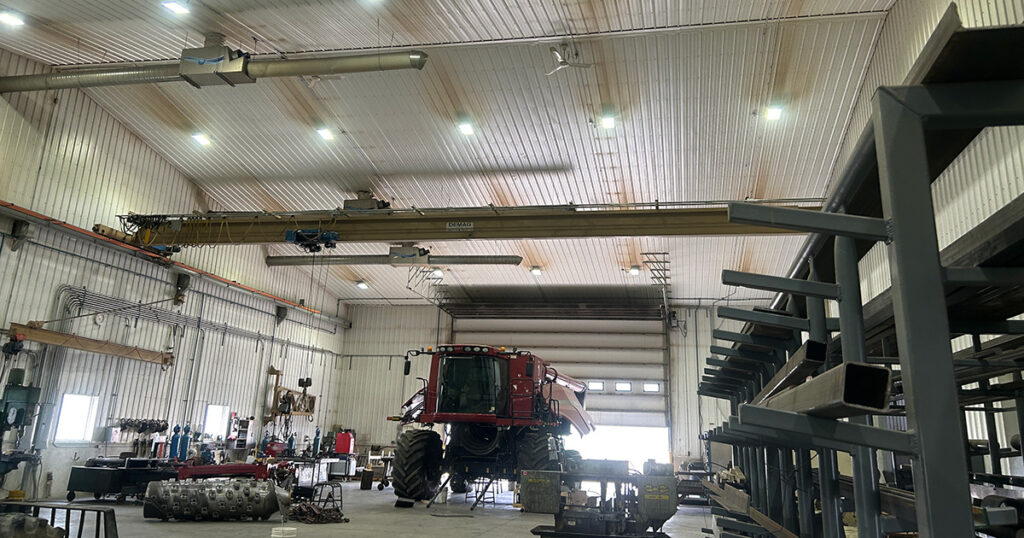
Underfloor heating in a tall shop deposits moisture wherever surfaces sit below the dew point. After a decade that grime line is visible from across the room — and the LED retrofit didn't cause it. It just stopped hiding it.
The Grime Line Time-Line
Hydronic underfloor heating doesn’t just heat your shop — it runs a recirculation loop that pushes warm, moist air up and pulls cool, dry air back down every minute the system is on. Wherever that moist air meets a surface colder than the dew point, water deposits. Dust and oil in shop air stick to those wet surfaces, dry, and repeat. Season after season, the film builds, and after about a decade there’s a band of grime on your walls and ceiling that traces exactly where the dew point lands inside your building. Older halogen and metal halide high-bays used to hide the ceiling portion of that band. The LED retrofit didn’t cause the grime — it just took the cover away.
The story owners keep repeating.
You’re not imagining that sequence. The timing is real. The physics is real. But the lights themselves are not the villain. They were just the last piece keeping a marginal ceiling above the line.
To see what actually happened, you have to start with the loop.
Your shop runs two systems at once.
Every hydronic shop runs two loops, not one. The water loop in the ground is the heating system you paid for. The air loop in the building is the one you didn’t — running anyway, every minute the boiler is on, against every cold surface in the room. One heats your floor. The other writes the grime line on your walls.
Here’s how the air loop works, step by step:
- The heated slab warms the air directly above it.
- That warm air rises through the worker zone.
- It hits the cold roof and dumps most of its heat through the steel to the outdoor sky.
- Now cool and heavy, it falls back down along the cold walls and overhead doors.
- At the floor, the slab warms it again.
That sequence repeats every minute the boiler runs. (Full physics breakdown here.)
Now add humidity. Shop air is always humid. Wash bays, snow melting off vehicles, workers breathing, equipment off-gassing, doors opening, parts steaming. That moisture rides the loop. It cycles top to bottom, and it lands wherever it meets a surface below the dew point.
That landing zone is where the grime lives.
Dew point is the actual line on your wall.
Dew point is the temperature at which water condenses out of air. It depends on both temperature and humidity. For a typical shop running 65°F air at 50% relative humidity:
Dew point = 46°F.
That number is the line. Any surface in your building below 46°F is actively pulling moisture out of the air. Anything above 46°F stays dry.
Walk through a typical hydronic shop on a −20°C day and rank the surfaces:
- Slab: 70°F — dry
- Air in worker zone: 65°F — moisture suspended, not deposited
- Lower walls (knee height): 60–65°F — dry
- Mid walls (chest height): 55–60°F — dry
- Upper walls (close to roof line): 45–55°F — borderline
- Ceiling / roof underside: 40–45°F — wet
- Overhead doors (uninsulated steel): 40–45°F — wet
- Door seals and frames: 35–45°F — wet
Notice the pattern. A clean lower half. A borderline upper half. And a soaking-wet ceiling and overhead door.
That isn’t a coincidence. That’s a thermal map drawn in a decade of grime.
What grime actually is.
Once moisture deposits on a cold surface, it doesn’t sit there pretty. Shop air carries dust. Shop air carries oil mist from compressors and equipment. Shop air carries diesel soot from idling trucks and tractors, welding smoke, tire rubber, brake dust. All of it stays suspended in the air column — until it meets a wet surface. Then it sticks. Fine particles in air also drift naturally toward colder surfaces on their own, which is why the cold zones in your building collect dust before condensation even starts. Once the surface goes wet, that drift turns into accumulation.
The cycle:
- Warm moist air hits a cold surface.
- Water deposits as a fine film.
- Suspended particulate — dust, oil, carbon — sticks to the wet film.
- The surface dries between cycles, leaving the particulate behind.
- Repeat thousands of times.
After ten or twelve years you don’t have water on your walls. You have a hard, dark, slightly oily film. Different owners call it different things: staining, discoloration, rust streaks, mildew lines, paint failure. It’s all the same thing. It’s a record of where condensation has been forming.
And the edge of that film — the boundary between dirty and clean on your wall — is the dew point line.
It’s not the cold — it’s the cycle.
Here’s the part most people miss. A ceiling sitting at 44°F continuously wouldn’t actually be the worst-case scenario. What ruins surfaces is the wet/dry cycling — moisture depositing, then drying with the dust and oil locked into it, then more moisture depositing on top of that, then drying again. Wet/dry is more aggressive than wet alone, and far more aggressive than dry alone. It’s the cycle that builds the film.
And the lights are what control the cycle.
A typical winter day on a hydronic shop ceiling looks like this:
- 6:00 AM — Lights have been off all night. Ceiling is at its coldest, well below dew point. Moisture has been depositing for hours.
- 7:00 AM — Lights on. Work starts. Ceiling begins warming.
- 10:00 AM — Ceiling reaches its daily high — only a few degrees above dew point with LEDs. Surface dries. The dust and oil that came down with the moisture get left behind, locked onto the dry surface.
- 5:00 PM — Lights off. Shop closes. Ceiling starts cooling.
- 7:00 PM — Ceiling drops back below dew point. New moisture starts depositing on top of yesterday’s layer.
- Midnight to 6:00 AM — Ceiling at its coldest. Moisture accumulating continuously.
- Next morning — Lights on, ceiling warms, surface dries. New particulate locks in over the previous day’s layer.
That’s two crossings of dew point per day. One moisture deposit per night. One drying-with-dirt-baked-in per day. 365 days a year.
Now the weekend amplifies it.
Friday at 5 PM the lights go off. They stay off through Saturday. They stay off through Sunday. They don’t come back on until Monday morning. That’s 62 continuous hours of below-dew-point ceiling — no warming interruption, no daytime drying, just slow steady deposition. Shops that only run weekdays — colony shops, farm-based operations, smaller crews — get even longer continuous cold periods. Holiday weeks make it worse again. A Christmas shutdown can leave the ceiling wet for ten or fourteen days straight.
Stack ten years of this on the ceiling:
- Daily cycles: ~3,650
- Weekend cold periods: ~520
- Long holiday periods: 30+
Every cycle deposits a microscopic layer. Every cycle picks up suspended dust and oil from shop air. Every cycle locks that layer in when the surface dries.
Where the retrofit fits in.
A 400-watt halogen or metal halide high-bay produces about 50 watts of visible light and 350 watts of heat. The housing runs 250–400°F in service, and these fixtures sit two or three feet below the ceiling, sometimes closer. Hot air rises off each housing and washes the ceiling. Infrared from the fixture body radiates upward. Across an array of six or ten older high-bays, that’s several thousand BTU/hr of incidental heat dumping into the ceiling zone.
That’s not much per square foot. But it was enough to keep a marginal ceiling — one sitting at 47 or 48°F — above the 46°F dew point. Just barely.
LED replacements pull about a third of the wattage and run cool. A 150-watt LED high-bay produces the same lumens as the 400-watt halogen, but its heat output is around 100 watts, and most of that gets shed through a heat sink into the room air below the fixture — not radiated upward to the ceiling.
Pull several thousand BTU/hr of incidental ceiling warming out of a shop and a ceiling that was sitting at 48°F drops to 44 or 45°F. That’s below dew point. That’s wet.
That is the moment your ceiling crossed the line.
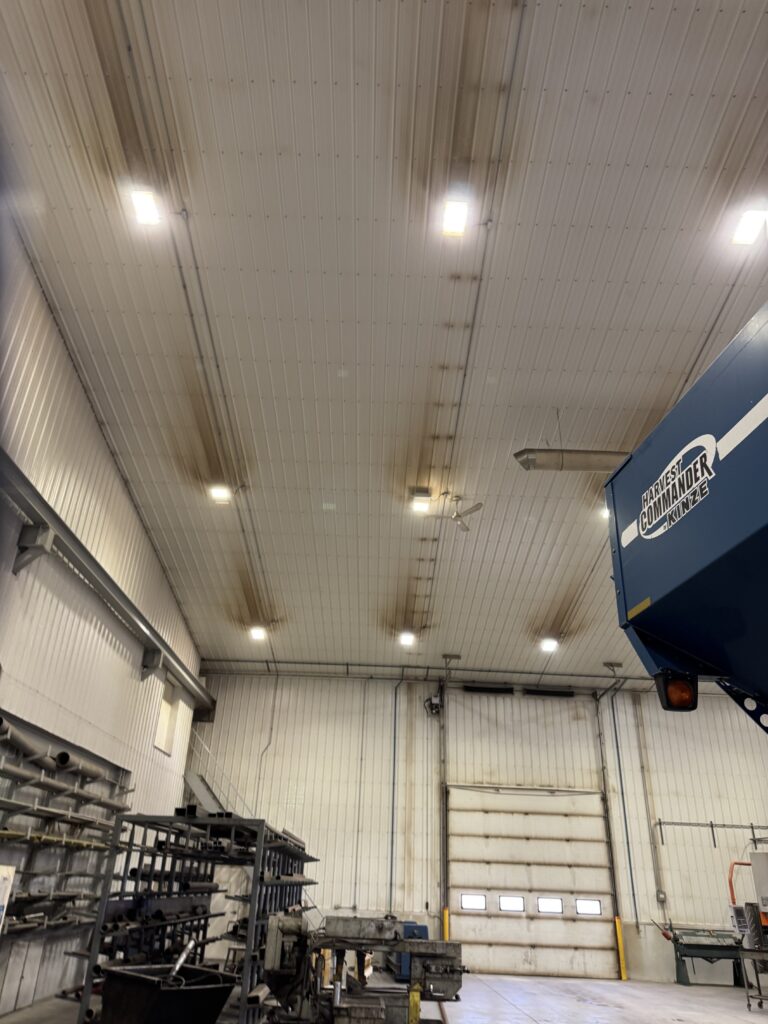
The lights weren’t doing anything to your building. The slab and the loop and the cold roof had been doing damage on the overhead doors and upper walls for years. The lights had just been providing a few free degrees of cover at the ceiling itself.
When that cover came off, the ceiling joined the rest of the grime map.
The second thing that happened at the same time.
The big LED retrofit wave in commercial Western Canadian shops landed between roughly 2014 and 2018, driven mostly by utility rebate programs. Most of those LED conversions didn’t show up alone. They came as part of broader energy upgrades — sealing door seals, replacing windows, adding insulation, adjusting ventilation rates. All good moves for fuel bills. All of them also raise indoor humidity, because moisture has fewer paths out of the building.
Higher humidity means the dew point itself moves up. A shop running at 65°F / 40% RH has a dew point of 39°F. The same shop after a tightening retrofit might run at 65°F / 55% RH, where the dew point is 48°F.
So at the same moment your ceiling lost its incidental lighting heat, the dew point you needed to stay above climbed three or four degrees. The two effects compound. The cold zones got slightly colder, and the dew point came up to meet them halfway.
That’s why a lot of shops saw grime spread down the wall after their LED retrofit, not just appear on the ceiling.
Reading your own building.
Walk into your shop tomorrow with a $40 infrared thermometer and a $30 hygrometer. Read the humidity. Calculate your dew point (every IR thermometer manual has the chart, or any phone app will do it). Then take surface temperature readings on:
- The slab
- Lower wall at three feet
- Mid wall at six feet
- Upper wall just below the roof line
- The ceiling itself, between fixtures
- The inside face of an overhead door
- The seal at the bottom of an overhead door
Mark which surfaces are below your dew point. Then look at where the grime lives on your walls and ceiling.
The two will match.
You’re not looking at a maintenance issue or a paint problem. You’re looking at a record of where your building has been wet for the last decade or so, written in dirt at the resolution of one degree.
You don’t notice it in your own shop.
The grime doesn’t arrive all at once. It builds up a season at a time — a winter of moisture deposition, a spring drydown, another winter, another spring. Each year adds a layer of film so thin you can’t see it. After a decade of cycles, the layers have stacked into a darkening that’s obvious from across the room. But because you’ve been looking at it the whole time, your eye doesn’t register it. Gradual is invisible.
You only see it the day you walk into a neighbor’s shop running overhead radiant. The ceiling is white. The walls are clean. The overhead doors aren’t streaked. And suddenly the grime in your own building, which has been quietly building up for years, becomes impossible to unsee.
From that point owners tend to split into two camps. Some go home embarrassed, rent a scissor lift, pressure-wash the ceiling, scrub the walls, and try to get the building back to where it was. Others look at the lift quote and decide to stop fighting it — and resolve that the next shop they build will not have underfloor heating.
The owners in the first camp are about to learn something the second camp already suspected.
The grime always comes back.
You can pressure-wash the ceiling, paint over the walls, replace ceiling tiles, swap out the door seals. Within a year or two the grime is back. Because the underlying cause hasn’t moved. As long as you’ve got a hydronic slab pumping warm humid air at cold surfaces, the building keeps depositing water on the cold zones. The film returns to the same line every time.
The only way to stop the grime is to stop the temperature differential. The roof, the walls, the overhead doors — all of them have to stay above dew point. The whole envelope has to come up to temperature, not just the floor.
This is what overhead infrared radiant heat does. A properly designed Reflect-O-Ray® system mounted at the ceiling radiates heat directly to every surface in the building. The roof, the walls, the overhead doors, the slab — all of them warm together as one envelope. There’s no cold ceiling for air to drop against. The overhead doors warm up. The seals stay above freezing. There’s no temperature differential, no recirculation loop, no path for warm moist air to find a cold surface to deposit on.
The same shop, two heating systems.
Same building, same wash bay, same humidity, same −20°C day.
Hydronic floor heating.
- Slab: 70°F
- Ceiling: 40°F
- Overhead door: 42°F
Multiple surfaces below dew point — moisture deposits, grime accumulates, repeat every winter.
Overhead infrared radiant.
- Slab: 70°F (warmed by radiant, not by boiler under the floor)
- Ceiling: 63°F
- Overhead door: 60°F
Every surface above dew point. Without the wet film, the dust and soot have nothing to stick to. They stay airborne, or settle to the floor where a broom handles them. The walls, ceiling, and doors never collect the layer in the first place.
The grime line either exists in your building or it doesn’t. Which one depends entirely on whether the building is being heated as one continuous envelope, or whether you’re heating the floor and asking the rest of the building to chase it.
• • •Conclusion.
Underfloor heating in a tall shop starts a moisture problem the day it’s commissioned. Most owners don’t see the damage at all because it accumulates slowly, and because halogen lighting was quietly hiding the worst of the ceiling effect.
Then, a decade in, the LED retrofit lands. The slab is still doing what it always did. The roof is still cold. The overhead doors are still cold. The only thing that changed is that the ceiling lost its incidental lighting heat at the same moment the building got tighter and a little more humid. The dew point line that had been hovering just above the ceiling drops onto it. From that winter on, every cycle of warm moist air against the cold ceiling deposits a little more film, and a few years later the ceiling looks like the overhead doors have looked for as long as anyone can remember.
That wasn’t the lights. That was the underfloor heating finally finishing the job it started the day it was commissioned.
If your ceiling is dirty and your overhead doors are rust-streaked and your upper walls are stained, you’re not looking at separate maintenance problems. You’re looking at the physics of a hot floor and a cold envelope, written across your building in dirt at exactly the line where dew point lives.
The cold envelope is the cause.
You don’t fix the marks on the wall by cleaning the wall. You fix them by warming the building.
Check your own shop. Take a humidity reading, calculate your dew point, and walk the walls with an IR thermometer.
Read the slab, the lower wall, the upper wall, the ceiling, the overhead door, and the door seal. Mark which surfaces sit below your dew point.
Then look at where the grime lives on your walls. The boundary on your building and the dew point on your thermometer will match.
If they do, the grime line on your building just told you what your heating system has been doing every winter for the last decade.
For the full physics breakdown of the recirculation loop that drives this whole effect, see Underfloor Heating: The Uncomfortable Truth About Hydronic Slab Systems.
This article reflects independent research and three decades of field observation across Western Canadian commercial buildings by Enviro-Smart Inc. It is intended for educational purposes and does not represent official technical literature, engineering position, or product claims of Combustion Research Corporation. All conclusions, interpretations, and recommendations expressed herein are solely those of the author.
Related articles from the same lane.

Reflect-O-Ray Radiant Heat in a Commercial Greenhouse
Side-by-side field observations from a working greenhouse: floor temperatures, root-zone temperatures, slab conduction, and what Reflect-O-Ray's flattened tube profile did for plant response over...
Read article
Quicker. Faster. Further. Stronger. Safer.
Two heaters can both be called "radiant" and behave nothing alike. Reflect-O-Ray's low-mass aluminized spiral tubing changes five specific things about how a radiant...
Read article
Let There Be Light
Infrared is the warming part of sunlight — invisible light that travels through cold air without warming it, then sinks into solid surfaces and...
Read article