
The Science of Infrared Heating in Poultry Barns
A deep scientific overview of radiant physics, mass activation, and the engineering principles behind next-generation low-intensity infrared systems.
Why Heating Mass — Not Just Air — Changes Everything
A deep scientific overview of radiant physics, mass activation, and the engineering principles behind next-generation low-intensity infrared systems.
1. The Fundamental Physics: Heat is Molecular and Atomic Motion
At its most basic level, heat is not a substance, and it is not air temperature. Heat is the energy stored in the vibration of atoms, molecules, and their electron structures. When infrared radiant energy strikes a solid surface, that wave energy is absorbed, and the molecular framework increases in vibration. This stored vibrational energy is what we experience as heat.
Radiant heating operates on this principle: it energizes the materials in the barn, not the air. Once energized, those materials gradually release heat back into the environment.
Radiant heating works by energizing the materials in the barn, not the air. The mass of the building becomes the heat reservoir.
Because solids retain that vibrational energy and release it slowly, the building — not the air — becomes the primary heat source.
2. Why Heating Air is Inefficient
Air is extremely poor at storing energy:
- it has very low density
- it mixes constantly
- it must be replaced during ventilation
- it cannot hold meaningful heat
Even if the air becomes warm, it quickly loses energy to the nearest available cold surface.
Worse still, the moment ventilation is required (which is always in poultry barns), warm air is removed and replaced with cold air. Any attempt to store heat in air is short-lived and fuel-hungry.
Heating the air is temporary. Heating the mass is lasting.
Barns heated through air always fight themselves:
- heat stratifies
- heat escapes
- cold infiltration forces systems to overrun
- humidity builds on cold surfaces
Mass-based radiant systems bypass the problem entirely.
3. The Core Principle of Radiant Heating
Infrared energy moves through the barn until it strikes something solid. When absorbed:
- the mass warms
- that mass becomes the heat source
- the barn stabilizes itself
This has three profound effects:
- Critical surfaces reach proper brooding temperature first
- Mass holds heat far longer than air
- Uniformly warmed surfaces create an evenly tempered environment
When the structure itself is warm, every movement of air brushes across warm surfaces. The barn conditions remain stable without aggressive convective heating.
When the mass is activated, the air naturally follows.
It does not need to be force-heated — it learns its temperature from the building itself.
Infrared-heated barns routinely show floor, wall, ceiling, steel, rail, feeder, and bedding temperatures all clustered within roughly 0.5–1.0°F.
This tells us the barn is in thermal equilibrium.
4. Evenness is Everything
Chicks thrive when the entire brooding zone sits inside a narrow temperature band. When barns exhibit hot spots near heaters and colder zones elsewhere, chicks are forced into constant behavioral correction:
- crowding
- scattering
- panting
- piling
- chilling
When every major surface in a barn sits within a degree — not five or twelve — chicks spread, feed normally, and settle. Bedding stays drier, respiration is calmer, and humidity is less likely to condense.
Uneven heat is stress. Even heat is health.
THE FIVE REFLECT-O-RAY ENGINEERING ELEMENTS
1. Front-End Combustion Control Tubes
Radiant tubes run hottest nearest the burner. If unmanaged, that front end develops an excessive infrared spike that over-heats the entry zone and starves the rest of the system.
Reflect-O-Ray uses specifically engineered combustion control tubes to temper this rise, creating balanced radiant output along the system instead of a hard front hot-spot that falls off downstream.
This smooths the radiant signature and enables full energy extraction over the entire run.
2. 22-Gauge Spiral System Tubing
The tubing itself is the true radiant engine.
Reflect-O-Ray’s 22-gauge aluminized steel spiral system tubing is optimized for:
- balanced emissivity
- extended radiant length
- downstream performance
- low-intensity, high-efficiency output
Instead of losing power deep into the run, the system maintains useful infrared until the natural taper near the exhaust.
3. Vacuum Venting
Vacuum venting is one of the defining advantages of Reflect-O-Ray system design.
By drawing combustion through the system rather than pushing it, combustion temperature, velocity, and extraction remain remarkably consistent.
This creates two key outcomes:
- radiant intensity remains balanced over long distances
- multiple burners can contribute to the same unified radiant system
Because the system is vacuum-vented, radiant output can be patterned to the barn itself, not limited to short straight lines.
Vacuum venting continuously renews the radiant output along the system, so intensity doesn’t fall off — it stays balanced until the final, intentional cool-down at the shared exhaust.
4. Radiant Pattern Engineering
Traditional radiant concepts behave as straight short sticks: single-direction runs that start hot and fade with distance.
Reflect-O-Ray approaches radiant delivery as an engineered pattern shaped to cover the barn. The system is designed to blanket the active flock area with low-intensity, gentle infrared that activates structural mass evenly.
This design produces system-wide mass activation without stacking short burners, without “recharging” fading sections, and without restricting heat to a straight line.
A radiant system should match the building. The building should never be forced to match the heater.
5. Measured Outcomes: The Proof
When radiant physics and purpose-built engineering work together, the data tells its own story:
- floors, walls, steel, feeders, and ceiling commonly fall within ~0.5–1.0°F
- surfaces remain warm enough to prevent condensation
- humidity struggles to accumulate
- ventilation becomes safer because incoming air moves past warm surfaces
- chicks settle evenly
- stress declines
Instead of attempting to heat air and hoping the air keeps barns warm, the structure becomes the thermal reservoir.
Every solid becomes a slow-release heater:
- walls
- feeders
- concrete
- steel
- ceiling
- even bedding
Warm mass creates warm air.
Stable mass creates stable barns.
Faster Dry-Out During Clean-Out Cycles
Barn sanitation depends on more than just detergents and disinfectants — it depends on how quickly the building dries after washing.
Infrared radiant systems shorten this period dramatically.
Because radiant energy warms the barn’s physical surfaces, water applied during clean-out lands on warm concrete, steel, and interior walls. Warm mass accelerates evaporation, allowing faster removal of residual moisture. That matters because most pathogens survive longest in damp conditions.
The result is:
- quicker post-wash dry times
- more effective disinfection
- reduced microbial survival opportunity
- faster turnaround between flocks
And instead of relying on warmed air currents to dry wet surfaces, the building itself becomes the drying engine.
Warm mass speeds sanitation, improves biosecurity, and gives the next flock a cleaner start.
Conclusion:
The Barn Must Become the Heater
Radiant heating is not warm air — it is electromagnetic energy that activates the physical structure. When mass becomes the heat battery, barns stabilize with almost no effort. Air is no longer the anchor. It simply follows the temperature of the building itself.
Reflect-O-Ray’s engineering exists for one purpose: to hold radiant strength all the way through the system so the building can absorb it, store it, and gently release it back as a unified climate.
Front-end temperature control, 22-gauge spiral tubing, vacuum venting, engineered radiant patterning, and shared exhaust design form a single platform: a balanced, long-reach, mass-activation system.
In these conditions we consistently observe:
- tight temperature spreads
- calmer brooding behavior
- drier bedding
- healthier respiratory conditions
- better feed efficiency
Because everything is warmed evenly.
And it all rests on one principle:
Heat the mass.
The air will follow.
When a radiant system is engineered to sustain mass activation across the footprint of the barn, the structure becomes the heater, conditions stay where you set them, and chicks thrive in the environment they were designed for.
[download_pdf url=”https://envirosmartinc.com/reflect-o-ray/pdf/Reflect-O-Ray-587-747-3753-Science-of-Infrared-Heating-in-Poultry-Barns.pdf” label=”Download Printable Poultry Science PDF”] [es_related_cards heading=”More on radiant & underfloor heating” urls=”https://envirosmartinc.com/2025/12/03/underfloor-heating/,https://envirosmartinc.com/2025/12/09/low-intensity-infrared-poultry/”]Related articles from the same lane.
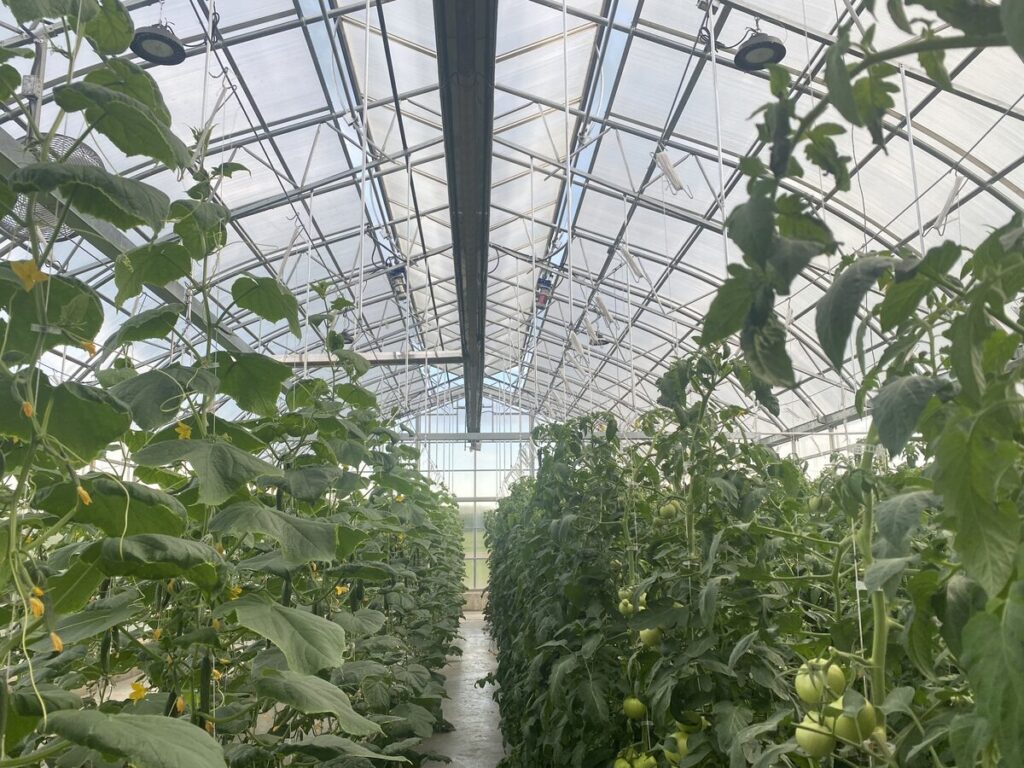
Reflect-O-Ray Radiant Heat in a Commercial Greenhouse
Side-by-side field observations from a working greenhouse: floor temperatures, root-zone temperatures, slab conduction, and what Reflect-O-Ray's flattened tube profile did for plant response over...
Read article
Quicker. Faster. Further. Stronger. Safer.
Two heaters can both be called "radiant" and behave nothing alike. Reflect-O-Ray's low-mass aluminized spiral tubing changes five specific things about how a radiant...
Read article
Let There Be Light
Infrared is the warming part of sunlight — invisible light that travels through cold air without warming it, then sinks into solid surfaces and...
Read article