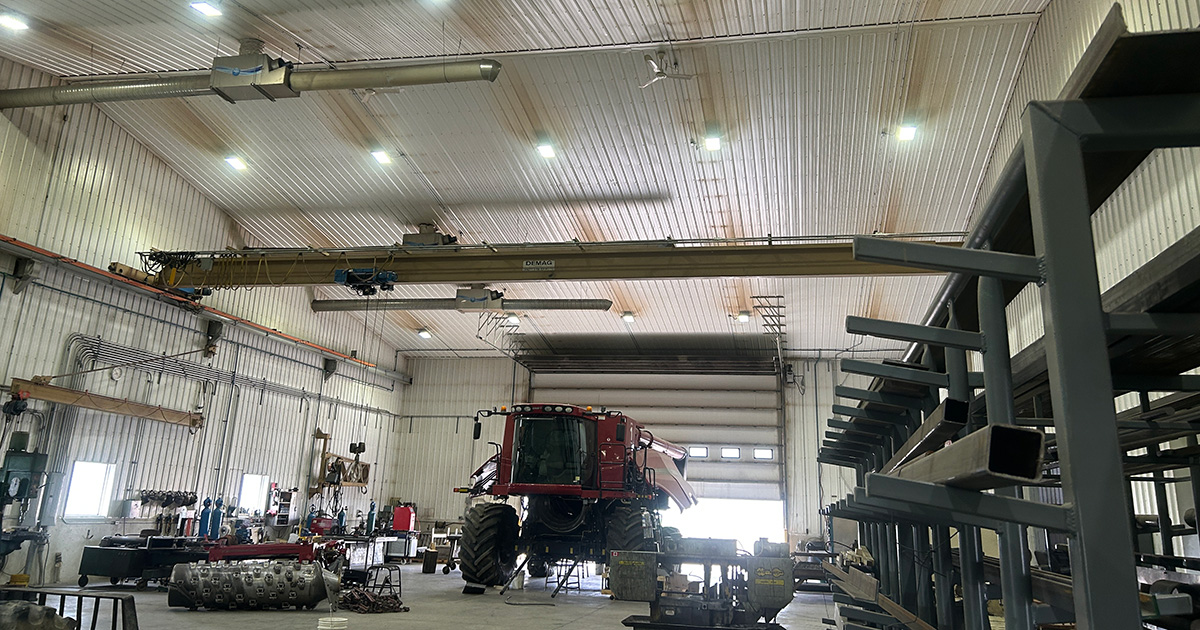
The Uncomfortable Truth About Hydronic Slab Systems
Many shops install hydronic underfloor heating because it seems like a straightforward application of basic physics.
If heat naturally rises, then placing the heat source at the lowest point in the structure feels like the logical place to start.
And in small, low-ceiling residential spaces — basements, small residential garages, bathrooms, utility rooms — heated slabs can work quite well.
Surfaces are close together, air turnover is minimal, and comfort is measured within a few feet of the floor.
The assumption is simple:
If warm floors feel good in compact rooms, and if heated air tends to rise, then extending that same approach into a larger, ventilated shop or barn should lead to similar results.
But when you scale from a small space to a wide, tall, constantly ventilated structure, the physics begin to behave very differently.
Large air volumes, open bays, cold surfaces, overhead doors, and rapid temperature swings push heat movement into a completely different category of thermodynamics.
This article examines underfloor heating specifically in the context of large shop environments (and any similar large ventilated structure, including barns), and what actually happens when heat begins at the slab in a tall industrial volume.
Not in theory.
Not in showroom demonstrations.
But in the real-world physics of a working building.
When those physics are followed all the way out, they reveal a much different story than the intuitive one we tend to begin with.
1. Why Underfloor Heating Struggles in Shops
Proponents of hydronic shops often lean on a familiar assumption: heat the slab, and the building will warm because “heat rises.”
It seems simple — until thermodynamics enters the room.
Here is the foundational problem:
The floor is the wrong surface to make the primary heat source in a tall, open structure.
Heat rises naturally, floors are high-mass and slow to respond, hydronic loops transfer warmth mainly through conduction rather than true radiant exchange, and the slab surface must be driven far above the desired room temperature just to push heat upward into the space.
That means:
- a colder day requires a hotter slab
- every weather swing lags by hours
- the entire building must endure the temperature required at the floor
And if workers need more comfort at shoulder height?
The slab must run hotter — long before the heat ever reaches them.
This is not radiant strategy.
It is a conduction attempt stretched over a building.
And that alone sets the stage for most of its failures.
2. The “Radiant” Claim
(And Why It Falls Apart in a Shop)
Hydronic brochures often describe heated slabs as “radiant systems.”
But true radiant heat begins as electromagnetic infrared energy interacting directly with mass — steel, walls, tools, equipment, vehicles, doors, and structural surfaces.
Hydronic slabs, by contrast, are simply:
- warmed water
- inside concrete
- delivering heat mostly by conduction
- and then slow, diluted convection through the air
And yes — any warm surface emits some infrared energy. So does a worker’s torso, the hood of a truck after a highway run, or a sun-baked tire.
But here is the uncomfortable physics:
To emit enough infrared intensity to genuinely warm mass throughout a tall shop — overhead doors, benches, tool chests, vehicles, structural steel — a slab would need to run at temperatures far beyond human comfort. In practice, it would have to be driven into surface temperatures so high that it becomes physically unsafe to stand, work, or walk on.
At safe operating temperatures, hydronic slabs simply do not emit strong IR.
They function mainly as conduction plates — warming the air slowly, unevenly, and only after the slab itself has been raised to temperature.
So in practice:
- slabs are capped at modest temperatures for comfort and safety
- they deliver heat primarily through conduction into air
- radiant effects are weak and quickly dissipate beyond a few feet
This is why the “radiant” claim fades fast in large shops.
At realistic slab temperatures, hydronics do not broadcast infrared into the building mass — they rely on slow, bottom-up air warming.
And that is a completely different physics profile.
3. Heat Rises — But Comfort Lives in the Middle of the Room
A shop worker does not live on the floor.
They live:
- roughly 34–68 inches above it
- surrounded by cold tools, trucks, steel, walls, doors, lifts, and bays
To heat that world from below, the slab has to push heat up through:
- slab → air conduction
- sluggish convection currents
- warm air pooling at the ceiling before anything else
People often picture warm air rising like a paint roller: as if it gently coats every surface with heat as it moves upward.
But that is not what actually happens.
A better way to picture it is this:
Imagine releasing thousands of tiny helium balloons from the floor.
They do not stop to “paint” the walls on the way up. They race straight to the ceiling and pack themselves into the highest volume of the room until that space is full. Only after the top layer is saturated does any meaningful warmth begin to drift down into the middle of the room.
Meanwhile, surfaces in the worker zone — toolboxes, doors, lifts, vehicles — remain much colder than the air that is floating past them.
Now add real-world operation:
- each time an overhead door opens, it is like popping a chunk of those balloons — the warmest air escapes first
- the system has to “refill the ceiling” before the middle of the room can stabilize again
- the air right above the slab is often the coolest point in the building, even though the floor itself may be hot
So the floor has to run hotter than natural comfort requires, just to overcome losses on the way up.
And that exposes the core flaw:
With hydronic underfloor heating, the slab is the only real heat store.
With true radiant systems, the slab is just one of many heat stores.
Hydronic floors attempt to warm the shop from the lowest mass upward — slowly, weakly, and against gravity.
Radiant tube systems start with the structure itself. Mass reaches equilibrium. The building becomes the heat source.
4. Slow Reaction Times:
Thermal Inertia vs Industrial Reality
Concrete holds enormous thermal mass. That sounds comforting — until the environment changes.
When the outdoor temperature moves suddenly, or when:
- overhead doors open
- equipment rolls in
- wind shifts
- humidity spikes in the wash bay
…the slab cannot react for hours.
The building temperature is chained to concrete inertia.
Which means:
- too hot long after sunny weather arrives
- too cold long after doors close
- slow to recover after heat loss
- constant over-correction cycles
Shops need:
- agility
- instant output
- fast shutdown
Hydronic floors cannot provide that.
They are slow boats turning on slow oceans.
5. The Insulated Slab Paradox
This part is rarely mentioned during the sales pitch:
Insulated slabs trap heat even when the system is off.
When you thermally isolate concrete from the earth, you remove its natural heat sink.
So in summer, even with the boiler off:
- the slab still holds energy
- the space never feels truly cool
- floors radiate warmth when no one wants it
- doors and fans become necessary just to normalize the building
Many shops eventually install cooling loops or chilled glycol just to remove heat from the slab.
Translation: you pay to heat the floor in winter — and you pay to cool it in summer.
Only because hydronic design requires insulating the slab in the first place.
6. Zoning Problems:
One Slab = One Temperature Reality
Different zones in a working shop demand different comfort levels:
- wash bays require aggressive heat
- bench work prefers a neutral environment
- welding zones tolerate hotter conditions
- storage corners need very little
But hydronic systems spread heat through one monolithic mass.
Even with loop segmentation, everything is interconnected through concrete.
If you raise wash-bay temperature to combat dampness, you raise the thermal load everywhere.
If mechanics want cooler floors to reduce fatigue, the entire slab cools.
Personal comfort is impossible because the platform is unified.
7. Humidity & Condensation:
The Silent Structural Warning Sign
Unless slabs are run aggressively hot, they often under-deliver heat to the upper structure.
The result: warm, moisture-bearing air contacts cold surfaces like:
- walls
- columns
- overhead doors
- steel framing
Condensation forms — followed by:
- stuck dust
- grease lines
- rust on tools
- streaked overhead doors
- discolored paint
Remember those thousands of tiny helium balloons collecting at the ceiling?
As that warm, moist air repeatedly hits colder structure and cools, it does not gently “paint” the building with heat. It leaves something else behind.
And the only “painting” happening on those walls and doors is not heat transfer — it is the grime, moisture streaks, and corrosion that hydronic stratification leaves behind.
8. Overhead Door Freeze-Ups:
Condensation’s Most Visible Consequence
When hydronic slabs under-deliver heat to the upper structure, overhead doors stay colder than the surrounding air. Panels, rails, track hardware, and especially rubber seals all sit below dew point, so warm, moisture-bearing shop air hits those cold surfaces and condenses. On mild days it shows up as beads or damp streaks, but when temperatures snap below freezing that moisture locks up: door seals bond to the floor, gaskets harden, rails frost and bind, panel edges freeze together, and door motors strain against ice. Ask any shop that relies on large doors: freeze-ups are not an accident — they are physics. If a structural surface stays colder than the air touching it, moisture will land on it; if temperatures are below freezing, that moisture becomes ice.
With true low-intensity infrared systems, the door structure is warm. Panels equilibrate with the building, gaskets stay pliable, and tracks shed moisture instead of collecting it. No cold surfaces means no condensation — and no freeze-ups. Shop owners switching from hydronic slabs to radiant systems report the same thing after their first winter: “Our overhead doors stopped freezing.”
9. Worker Fatigue & Productivity Loss
Hot Floors Aren’t Harmless
Hydronic slabs are often forced to run hotter than anyone would naturally choose — not for comfort at foot level, but simply to push enough heat upward to warm the building. And that has consequences.
Research in ergonomics and occupational heat stress shows that elevated temperatures around the feet and lower legs can contribute to increased physical fatigue during long shifts. Concentrated thermal loading at floor level has also been linked to reduced comfort over time, and even modest overheating at the lower body can compound strain for people who spend their days standing and working.
When heat is delivered from the bottom up, circulation patterns change, muscle endurance can drop, and overall comfort declines — especially in environments where workers remain on their feet for extended periods.
Here’s the reality most hydronic shops eventually come to terms with:
To make the room comfortable, the slab often has to run hotter than workers would ever choose underfoot. And when that happens, the trade-off isn’t just extra runtime or higher fuel consumption — it’s preventable strain on the people doing the work.
A hot floor might warm the air eventually, but part of the cost is paid through the workforce itself:
- reduced focus
- more frequent pauses to cool down
- a slower working pace
- end-of-shift exhaustion
You’re not just heating concrete.
You’re heating bodies.
And in a high-skill environment where precision matters, endurance, clarity, and comfort are the assets worth protecting.
10. Wash Bays:
Where Physics Turns Against Hydronics
Wash bays introduce moisture. A hydronic slab tries to force heat upward, but walls, overhead doors, and structure often remain colder than the air, so moisture collapses onto those surfaces. Visible patterns appear as dark condensation lines, dirt gradients, and corroded hinges and hardware. In contrast, where mass is fully warmed and surfaces share a tighter temperature profile, wash bays dry faster, walls stay cleaner, and condensation gradients nearly disappear.
11. Constant BTU Overbuild
Because underfloor heating must fight upward losses, boilers are oversized, loops multiply, runtime increases, and fuel bills grow. On paper, a boiler may boast combustion efficiencies in the high 90s, but if that “high-efficiency” heat source has to run constantly just to maintain comfort in a poorly matched distribution system, the building does not experience efficiency – it experiences long runtimes. If an engine must be pushed continuously just to maintain comfort, it is not efficient where it matters. True efficiency shows up in how often the system can afford to be off.
12. The Final Physics Problem
Underfloor heating attempts to use heat stored in one surface (the slab) to warm a building full of unheated mass.
Walls, doors, equipment, steel, benches, lifts, stairs, tools — all remain colder than the air.
These surfaces become:
- heat sinks
- condensation targets
- comfort killers
Shops do not need warm floors.
They need:
- warm mass everywhere
- consistent surface temperatures
- no cold nodes
- no condensation anchors
13. What Real Radiant Systems Do Differently
A true low-intensity infrared system reverses the starting point. It begins at the ceiling and throws IR into the walls, tools, steel, equipment, slab, benches, vehicles, doors, and structural surfaces so that everything becomes thermally active. As mass equilibrates, temperatures stabilize, humidity collapses, condensation disappears, comfort profiles tighten, response time accelerates, and wash bays dry fast.
When summer shutoff comes, the space immediately returns to neutral. And because the building itself becomes the heat reservoir, the system cycles less often: true efficiency is runtime. When the mass of the building does the heavy lifting, the burner doesn’t have to.
14. Conclusion
Hydronic underfloor heating has earned its place in small residential spaces, where rooms are low, surfaces are close, thermal loads are predictable, and comfort is judged within a few feet of the floor.
But in large shops — especially in northern climates or ventilated agricultural barns — the physics change.
Tall building volumes, cold exterior walls, heavy moisture cycles, wash stations, rapid weather swings, continuous air turnover, and worker comfort demands all expose the structural limitations of slab-based heat.
Slow reaction time, condensation risk, summer discomfort, overheating cycles, worker fatigue, and higher operating costs are not quirks.
They are consequences tied directly to thermodynamics.
If heat begins at the floor, you end up battling heat stratification, thermal inertia, and cold mass. But when heat begins at the structure — as with true low-intensity infrared radiant systems — the entire building becomes the reservoir.
And that contrast is the uncomfortable truth.