
How Heat Actually Moves
A plain-talk explainer. Same fuel. Same energy. Two completely different barns. The difference isn't in the equipment specs — it's in the physics of how heat is delivered.
There are only three ways heat moves.
Conduction, convection, and radiation.
Every heating system on earth — every fire, every radiator, every furnace, every infrared tube — moves energy using one or more of these three mechanisms. Understanding the difference between them is the difference between picking a heating system that works for your barn and picking one that fights against it.
Two ways to heat a barn.
Same BTUs in. Very different heat out.
Take the same barn, the same outside temperature, and the same total BTU output. Run it through a hot water system and run it through Reflect-O-Ray. The energy delivered to the floor — where the birds actually live — is dramatically different.
The first 48 hours decide everything.
And it’s the one job hot water cannot do.
Day-old chicks have very little thermal mass. Their bodies cannot tolerate moving air. They need a warm floor from the moment they’re placed — not a warm air column, not a heated thermostat reading, but actual warm surfaces underneath them. Hot water heating depends on moving air. Reflect-O-Ray doesn’t.
Many Reflect-O-Ray producers run no minimum ventilation for the first 7–10 days, because the system isn’t generating combustion byproducts inside the barn and the dry, warm floor controls humidity naturally. Producers running hot water systems next door are usually pulling air long before that — not because the chicks are ready, but because the heating system can’t manage moisture on its own.
What the same BTU has to do, in each system.
The complete picture, end to end.
The same unit of energy ends up in very different places depending on what equipment you bought. Here’s how those BTUs spend their day.
| Hot Water (Hydronic) | Reflect-O-Ray (Infrared) | |
|---|---|---|
| Heats first | The water in the pipes | The tube surface (instantly red-hot) |
| Heat travels by | Water → air → object | Infrared waves through the air |
| Where heat lands first | The ceiling | The floor, walls, animals, and equipment |
| Air movement required? | Yes — circulating fans must run constantly | No — works in still air |
| Bird-level temperature | Cooler than the thermostat reads | Matches the thermostat — or warmer |
| Brooding stage | Fights itself: chicks need still air, system needs moving air | Floor warm from minute one. No conflict. |
| Drafts at floor level | Always present from circulating fans | None |
| Chick distribution | Piled in corners, escaping drafts | Spread evenly across the floor |
Same BTUs. Same fuel. Completely different outcomes — because where the energy lands and what it warms first decide everything that happens after.
Heat held in the mass
The floor and structure become the heat reservoir. Outdoor swings stop pushing the barn around.
Drier litter from day one
A warm floor evaporates moisture before it builds. Less caking, less ammonia, less topdressing.
Faster cleanout & dry-down
The barn dries from the floor up between flocks. Turnaround time shrinks meaningfully.
Lower runtime
No fuel spent heating air the chicks never feel. The system fires less because the mass is already warm.
Ready to see what this looks like
in your barn?
Free layout consultations across Western Canada and Montana. We’ll walk through your barn dimensions, current setup, and what a Reflect-O-Ray installation would look like for your operation — no pressure, no charge.
Related articles from the same lane.
Why Most Radiant Heat Doesn’t Work
The pattern most producers actually saw — and why no amount of tuning was ever going to fix it.
Read article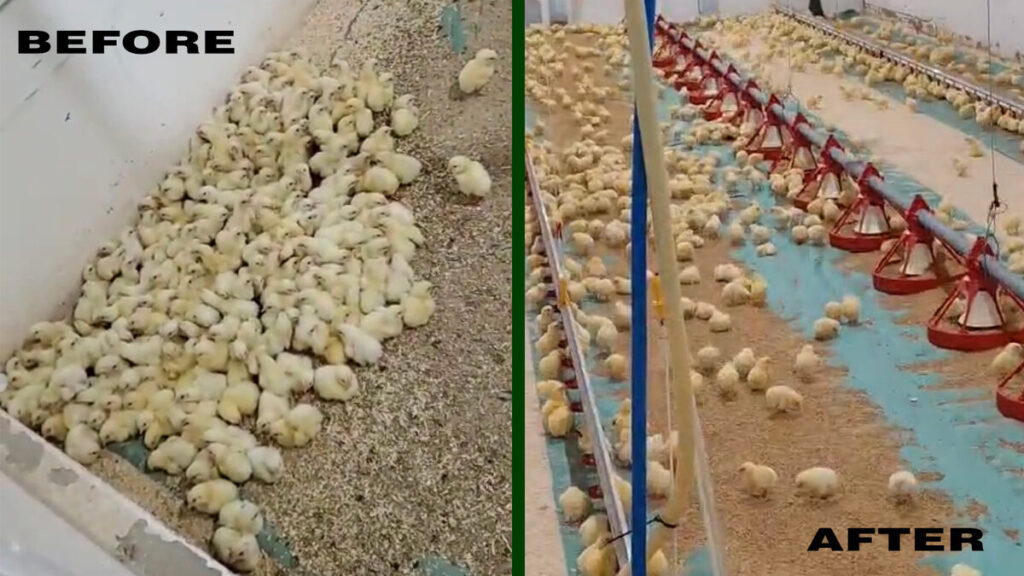
What Your Chicks Know That Your Thermostat Doesn’t
Bird behavior is the most honest temperature sensor in your barn. When the chicks crowd the corners, they're not telling you the corners are...
Read article
Reflect-O-Ray: Everything Heating
Air temperature isn’t barn temperature. A barn is floors, walls, cages, and the ceiling. When all of those sit close in temperature, the room...
Read article