
What Your Chicks Know That Your Thermostat Doesn’t
Bird behavior is the most honest temperature sensor in your barn. When the chicks crowd the corners, they're not telling you the corners are warm. They're telling you something else entirely.
What Your Chicks Know That Your Thermostat Doesn’t
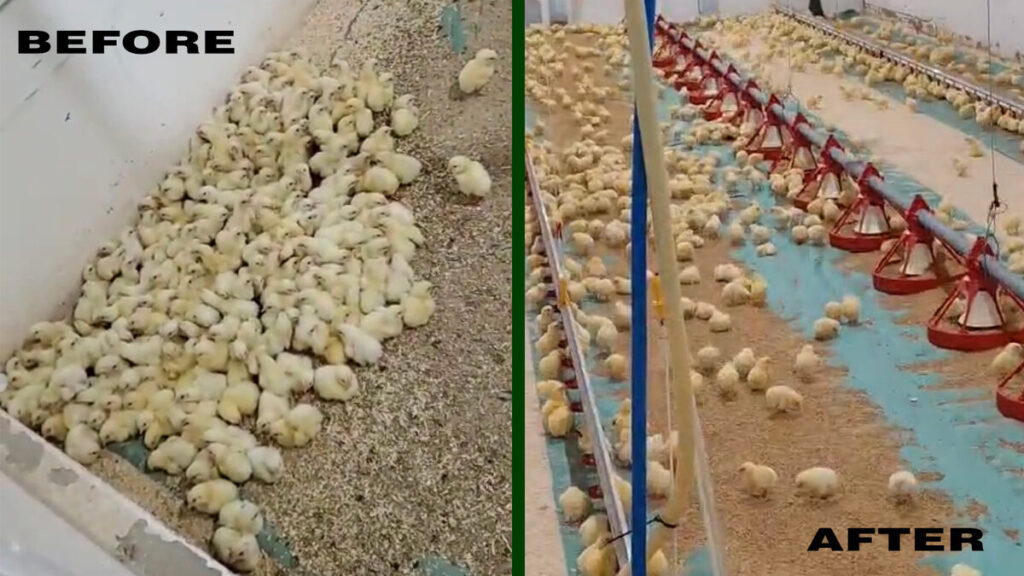
Day-old chicks have almost no thermal mass. Their nervous systems drive them toward the spot in the barn with the least heat loss — and in a hot-water-heated barn, that spot is almost always a corner. Not because the corners are warmer (they aren’t), but because they’re the only place sheltered from the air movement the heating system depends on to deliver heat to the floor. The corner pile is a thermal map drawn by the birds themselves. Switch to overhead radiant and the floor itself becomes warm: the corner advantage disappears, the pile breaks up, and the birds spread evenly across the floor.
Every experienced poultry manager has heard the same advice from the old-timers: watch the birds. The thermostat will tell you what the air says. The production metrics will tell you the final result. But the birds will tell you what is actually happening in the barn — at the level where it matters, in real time, without being filtered through a sensor that only reads one spot in the air column.
This isn’t folk wisdom. It’s biology. A day-old chick has very little thermal mass. It loses heat fast. Its entire nervous system is built to drive it toward the spot in the barn with the least heat loss. If you watch where the birds settle, you are watching a 24-hour-a-day thermal map of your barn — far more accurate than anything the thermostat is showing you.
And one of the most common things that map shows is corner-piling.
The corner pile.
In a hot water heated barn during brooding, a familiar pattern emerges: the chicks abandon the center of the floor and pile into the four corners and along the walls. The center looks empty. The corners look overcrowded. To a manager who hasn’t seen it before, the instinct is “the corners must be warmer.” That instinct is wrong.
The corners are not warmer. In most cases they are slightly colder, because two exterior walls meet there and double the conductive heat loss to the outside. A thermometer in the corner and a thermometer in the center will often read the same air temperature, or the corner will read a degree or two lower.
So why do the birds go there?
Because the corners offer something the rest of the floor doesn’t. They offer shelter from air movement.
Felt temperature: why air movement changes everything.
There is a difference between the temperature your thermometer reads and the temperature your body feels. Scientists call the second one operative temperature — the combination of air temperature, surrounding surface temperatures, and any air movement across the body. It’s the same principle as wind chill on a winter day: 25°F with no wind feels different than 25°F with a 20 mph wind, even though the air itself is the same temperature. Poultry science journals and industry references consistently describe this as “effective temperature” — and it’s well-documented that air movement across young birds creates a real wind chill effect that dramatically lowers what the bird actually experiences.
For an adult chicken, the difference between still air and moving air is uncomfortable but tolerable. For a day-old chick — small, downy, with almost no thermal mass — that same difference is the line between thriving and dying. Industry guides note that chicks are extremely sensitive to cold air movement during the first days of life, before they have developed adequate thermal insulation. A draft of even 50 to 100 feet per minute moving across a chick can drop its felt temperature significantly. The chick’s nervous system reads that as cold. Not “slightly cooler.” Cold.
Now consider what’s happening in a hot water barn during brooding. The thermostat reads correctly. Hot water pipes along the sidewalls or overhead are heating the air. Circulating fans are pushing some of that warm air down toward the floor — because without those fans, the warm air just stratifies at the ceiling and never reaches the birds.
But circulating fans don’t deliver heat evenly. They create columns and zones of moving air. And from a chick’s perspective, every moving column of air is a draft. The center of the barn — where the fans are most effective at delivering air — is also where the chick feels the most movement across its body.
The corners, meanwhile, are protected. Two walls block the airflow on two sides. The pile of other birds blocks it on a third. The air in the corner is the calmest air in the barn. So the chick’s nervous system reads “corner = least heat loss” and drives the bird to the corner.
The penguin dynamic.
Once a few birds settle into a corner, the rest follow. This is exactly the dynamic emperor penguins use to survive Antarctic winters: huddle tightly, share body heat, rotate the position of the birds on the cold edges. In a poultry barn the math is the same, but the consequences are harsher because chicks have far less reserves than adult penguins.
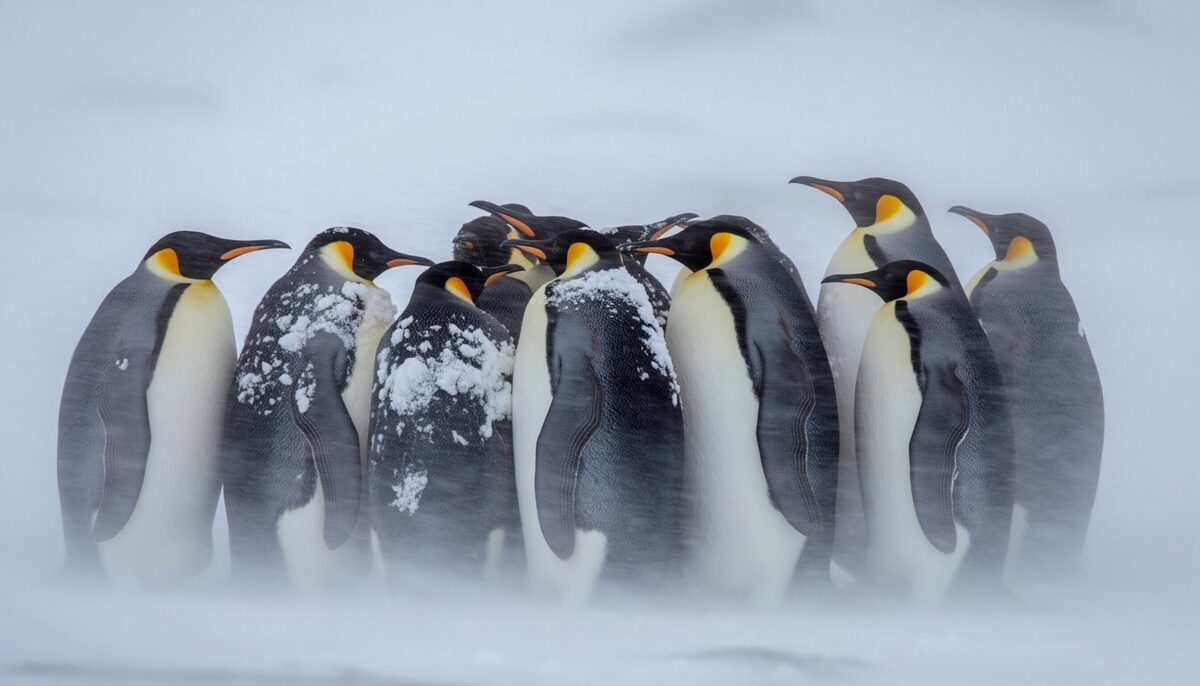
The birds in the center of a pile are insulated by the bodies around them. Their own metabolic heat gets trapped in the pile. They are warm, but they can also overheat or suffocate if the pile gets too dense.
The birds on the outer ring are exposed on one side. They burn more energy to stay warm.
The birds at the very edge are exposed on most sides. They keep trying to push into the pile. They burn through their reserves trying. Many of them don’t make it.
This is where the early mortality numbers come from. Not from a single dramatic failure, but from days of birds at the edges of the pile slowly losing the energy battle. By the time the manager notices the problem, the losses are already locked in.
Why hot water heating builds the trap.
The frustrating part for a hot water producer is that every available response makes the problem worse. The system fights itself.
If the manager turns up the thermostat, the boiler runs harder, the pipes get hotter, more warm air rises to the ceiling — and almost none of it reaches the floor. The thermostat eventually reads “right” and shuts off the call for heat, while the floor temperature has barely moved.
If the manager runs the circulating fans harder to push more warm air down, the drafts get worse. The birds pile tighter. The corners become more crowded.
If the manager opens up the ventilation to clear moisture or ammonia from the wet litter, cold outside air enters the barn before the warm air has had any chance to deposit energy into the floor or walls. The temperature crashes. The birds pile even tighter.
There is no way out of this loop with a heating system that depends on moving air to deliver heat to the floor. The brooding stage is the one period in a chick’s life where you cannot tolerate air movement, and it is also the period when a hot water system is least able to deliver heat without it.
This isn’t a maintenance issue or a management failure. It’s the fundamental physics of trying to use convection to do the job of radiation.
Physics meets biology.
To be clear about what’s being argued here: this isn’t an indictment of any particular hot water installation. The best-designed hydronic system in the world still has to move air to deliver heat. The youngest, most vulnerable chick still cannot tolerate moving air. Better equipment, better management, and better controls can soften the conflict. They cannot resolve it. The conflict is built into the choice of system, not the quality of the install.
Even in a modern, well-designed hot water barn — newer boiler, properly sized loop, current controllers, thoughtful circulating fan layout, good insulation, an experienced manager — the corner-piling pattern still emerges during brooding. It might be less dramatic. The mortality might land at three percent instead of five. The cold zones might be smaller. But the underlying pattern is still there, because the underlying collision of physics and biology hasn’t changed.
This is why the producers who switch to radiant heat from competently-run hydronic systems describe such a stark before-and-after. The change isn’t from “broken” to “working.” It’s from one set of physics to another.
• • •Viking Colony, before and after.
Viking Colony in Alberta operates seven broiler barns of varying ages and insulation. Their original hot water system did exactly what hot water systems do: it heated the air, the air rose to the ceiling, and the chicks piled into the corners. Manager Josh recorded a video inside one of those barns when the system was failing. Outside it was deeply cold. Inside, the thermostat read 32°C at the controller. And in the middle of that barn, with the air reading right at target, the birds were jammed into the four corners. The center was empty.
After Viking switched to Reflect-O-Ray infrared radiant heating across all seven barns, Josh recorded a follow-up walk inside the same buildings. Same outside conditions. Same chick density. The birds were spread evenly across the entire floor. A few here and there happened to be near the corners — because that’s just where they happened to be standing, not because they were forced there. The crowding was gone. The piling was gone.
What changed was not the thermostat. The thermostat in both situations could have read the same number. What changed was the thermal environment. With infrared, the floor itself is warm. The litter is warm. The walls are warm. The bird’s felt temperature equals the actual air temperature equals the floor temperature. There is no advantage to the corner anymore — because there is no draft to escape, and every spot is a warm spot.
The birds spread out because their nervous system finally read the same answer everywhere.
What the industry tells itself.
If you read industry literature on poultry brooding management, the corner-piling problem is well known. The Aviagen ROSS Broiler Pocket Guide — a global standard for broiler producers — explicitly identifies the pattern. Under “Monitor Chick Behavior,” it lists four conditions the manager should be able to read from the birds: temperature too high, temperature correct, temperature too low, and draft — defined as “chicks huddling in one area of the surround.” The industry knows exactly what corner-piling means.
The Government of Saskatchewan brooding guide puts it even more plainly: “Despite what the thermometer reads, ensure temperature is adjusted based on behaviour of the chicks.” Western Canadian extension offices have been telling producers for decades that the bird is a more reliable instrument than the controller. The University of Georgia’s poultry extension makes the same observation, noting that chicks experiencing drafts “can be seen huddling together (even next to the side wall).”
The recommended fixes in industry literature are familiar: improve circulation, increase floor temperature uniformity, reduce drafts, adjust ventilation timing, monitor closely during the first week.
What that advice doesn’t say — but what producers experience every cycle — is that those fixes describe the symptom and prescribe what amounts to “make your heating system not be the kind of system it is.” A hot water system cannot deliver heat without moving air. A forced-air system cannot warm the floor without stratifying. The advice is real. The fixes mostly don’t work, because the underlying physics doesn’t allow them to.
This is why the producers who have switched to radiant heat describe it as a different category of system, not a better version of the same thing. It isn’t a small improvement on convection. It is a different way of getting energy into the barn, with different physics, and as a result, different bird behavior.
What the birds are really telling you.
The thermostat measures air at one location. The birds measure everything: surface temperatures, drafts, comfort, the felt environment as a whole. And they vote with their feet, every minute of every day, in a language that anyone willing to walk through the barn can read directly.
The old-timers were right. Watch the birds. They’re showing you the truth.
Radiant heats barns.
When the floor is warm, every spot is the warm spot — and the birds finally have nothing to escape from.
Reflect-O-Ray® is a product of Combustion Research Corporation. This article is produced independently by Enviro-Smart Inc. Field observations referenced from Viking Colony, Alberta. Performance and behaviour observations may vary depending on facility design, management, insulation, and climate conditions.
Related articles from the same lane.
Why Most Radiant Heat Doesn’t Work
The pattern most producers actually saw — and why no amount of tuning was ever going to fix it.
Read articleHow Heat Actually Moves
A plain-talk explainer. Same fuel. Same energy. Two completely different barns. The difference isn't in the equipment specs — it's in the physics of...
Read article
Reflect-O-Ray: Everything Heating
Air temperature isn’t barn temperature. A barn is floors, walls, cages, and the ceiling. When all of those sit close in temperature, the room...
Read article